 Available in US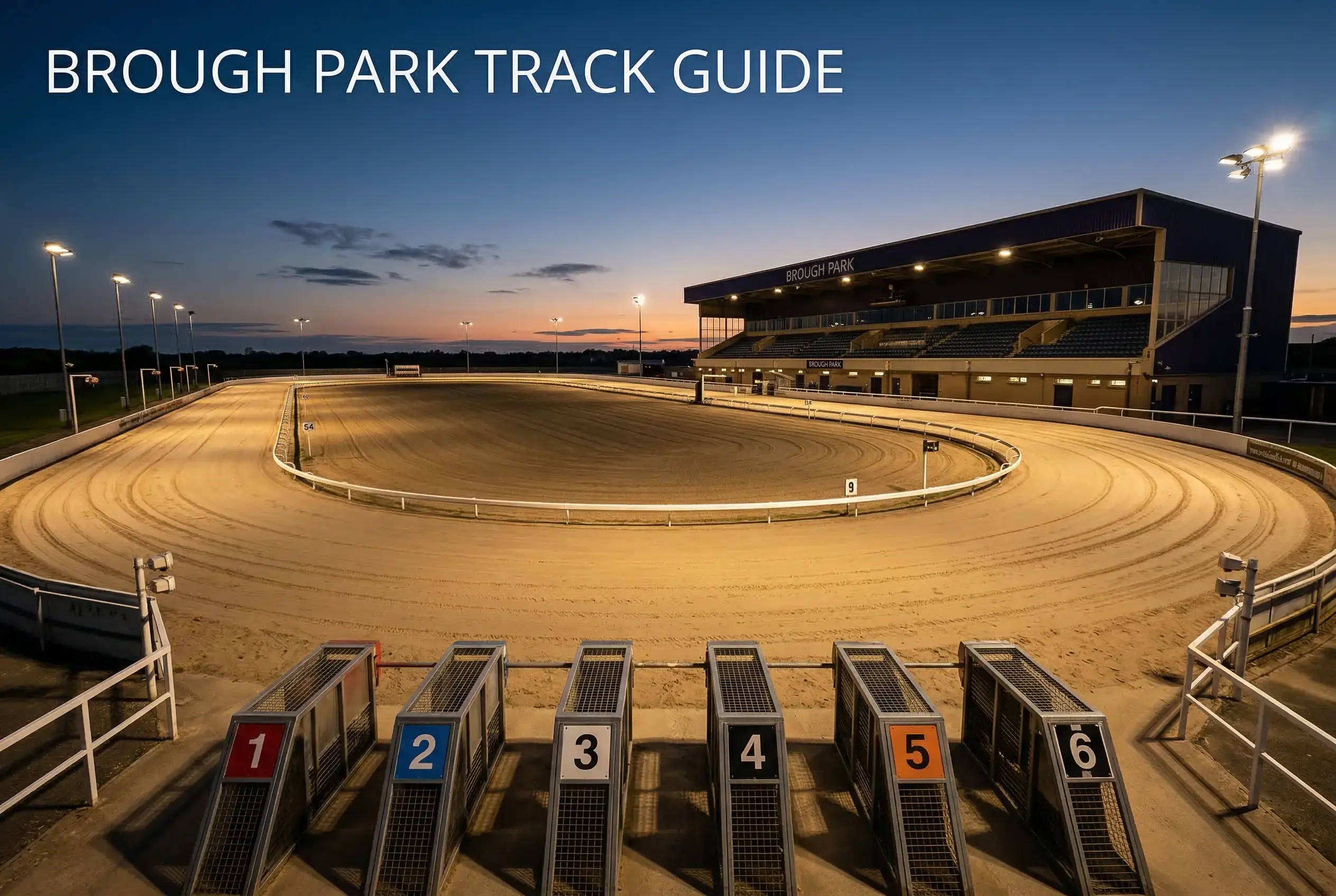
Inside Brough Park: The Complete Newcastle Greyhound Track Guide
Every greyhound track has a personality. Some are tight, punishing circuits where railers dominate and wide runners get swallowed on the bends. Others are sweeping, generous ovals that reward pace over position. Brough Park, home to Newcastle greyhound racing since 1928, falls somewhere in between — and that is precisely what makes it one of the most interesting tracks in the country to study.
This Newcastle greyhound track guide breaks the venue down to its bones: the 415-metre circumference, the sand surface that shifts character with the weather, the Swaffham hare system, and the distances that range from 290-metre dashes to gruelling 895-metre marathons. Whether you are reading racecards for the first time or recalibrating your approach after years of following the dogs at other venues, understanding the physical track is where serious form study begins.
Newcastle runs fixtures on Tuesdays, Wednesdays, Thursdays and Saturdays, hosting a mix of daytime BAGS meetings for the betting shop audience and evening cards that draw local crowds through the turnstiles. It is one of only a handful of northern tracks still operating under a GBGB licence, and the only one in the North East staging Category 1 events such as the All England Cup. The track itself — its bends, its surface, its hare — shapes every result that comes out of Byker. If you want to understand Newcastle greyhound results, start here.
See also: newcastle greyhound results — the Newcastle greyhound racing hub.
Track Circumference, Bends and Run-Up Distances
Brough Park measures 415 metres around the outside of the running rail. That puts it in the mid-range among GBGB-licensed tracks — larger than the tight 334-metre circuit at the now-closed Crayford, smaller than the wide-open 460-metre circuit at Towcester. It is a four-bend track with a standard oval configuration: two relatively short straights connected by two sweeping bends.
The bends at Newcastle are where most races are won and lost. They are not especially tight by UK standards, but they are far from forgiving. A greyhound that checks on the first bend at Brough Park can lose two or three lengths in a heartbeat, and on shorter distances there is simply not enough straight to claw that back. The geometry of the bends also means that inside runners — traps one and two — carry a natural advantage in the initial scramble for position. The data behind that claim is well-documented across UK greyhound tracks, but the track shape is the reason it exists.
The run-up distance is the stretch from the starting boxes to the first bend. At Newcastle, this varies depending on which distance is being raced, but the principle remains constant: a longer run-up gives outside runners more time to find the rail before the first bend compresses the field. On the 480-metre trip, the standard distance for most graded races, the run-up is long enough to allow a reasonable amount of early jostling without immediately punishing wide runners. On the 290-metre sprint, the first bend arrives almost instantly, and the inside boxes become significantly more important.
Understanding run-up distances matters because it changes the value of trap draws. A trainer placing a wide-running greyhound in trap six at Newcastle knows the dog needs clear early ground. If the race is a 290-metre sprint, the maths is against them from the off. If the race is a 680-metre staying trip, there is more time and space to work with. The track circumference and bend configuration are not abstract measurements — they directly influence which greyhounds win and which ones spend the race chasing shadows.
It is worth noting that Newcastle’s 415-metre circumference creates what experienced punters call a “neutral” track. It does not excessively favour railers the way some tighter circuits do, nor does it wash out trap bias the way the biggest ovals can. The bends tighten just enough to test a greyhound’s balance and the straights are just long enough to reward late pace. For anyone studying Newcastle greyhound results, that balance is the defining feature of the track’s geometry.
Sand Surface and Going Allowance at Newcastle
Newcastle runs on a sand surface. That single fact shapes everything from finishing times to injury risk, and it separates Brough Park from the handful of remaining British tracks that still use an older-style galloping surface. Sand became the industry standard over the past two decades for one overriding reason: it is safer. Across all GBGB-licensed tracks in 2024, the injury rate stood at just 1.07% of all runs — a record low. Sand surfaces played a significant part in driving that number down, absorbing more impact on the bends and reducing the kind of skeletal injuries that harder surfaces produce.
But safety is only half the story. Sand also changes how races unfold. A freshly graded, well-watered sand track runs fast — typically classified as “Normal” on the going report. As the evening progresses and the surface dries or gets chewed up by repeated races, times tend to slow. Rain during a meeting can compact the sand and bring times back down, or — if it falls heavily — create a drag effect that slows everything. This is why you will sometimes see two meetings at Newcastle in the same week produce significantly different average times over the same distance.
The going allowance is the adjustment applied to raw finishing times to account for the speed of the surface on any given night. It is expressed in lengths per distance — for example, “slow three” means the surface is running three lengths slower than a standard time for that distance. When you see a greyhound clock 29.50 over 480 metres on a night declared “slow two,” the adjusted time might be closer to 29.20 on a standard surface. Without applying the going allowance, you are comparing apples to oranges every time you look at form from different meetings.
At Newcastle, the going tends to run in a fairly consistent range. The sand at Brough Park is well maintained, and the track staff grade the surface between races to keep conditions as uniform as possible across a card. That said, seasonal variation is real. Winter meetings at Newcastle, with colder temperatures and more moisture in the ground, typically produce slower going than summer cards. A greyhound that looks sluggish on a December Wednesday may simply be dealing with heavier ground rather than fading form.
For anyone trying to assess form at Newcastle, the going allowance is not optional information — it is essential. The raw time on a result card tells you how fast a greyhound ran. The going allowance tells you how fast the track was running. Only by combining the two can you get an honest picture of a dog’s performance. Ignoring it is like judging a sprinter’s 100-metre time without checking whether they ran into a headwind.
Graded, Open and BAGS Meetings: How Newcastle Races Are Classified
Not all race meetings at Newcastle are created equal, and understanding the difference between graded, open and BAGS fixtures is fundamental to reading the track’s output. The classification system determines the quality of the fields, the stakes on offer, and — crucially for punters — how competitive and predictable each race is likely to be.
Graded races are the bread and butter of Newcastle’s card. In a graded race, greyhounds are grouped by ability using a banding system. The racing manager assesses recent form, times and gradings to assemble fields where every dog in the trap has roughly the same chance. An A1 graded race features the fastest greyhounds at the track; an A10 or A11 race features those at the lower end of the grading ladder. The purpose is competitive balance — tight finishes, close margins, and the kind of races that keep the betting market honest. For punters, graded races are generally the hardest to solve because the field is deliberately even. For casual racegoers, they produce the most exciting finishes.
Open races sit above graded racing in the hierarchy. These are invitation events or races open to entries from any licensed trainer in the country, not just those based at Newcastle. Open races tend to attract stronger greyhounds because the prize money is higher and there are no grading restrictions on entry. The All England Cup, Newcastle’s flagship event, is an open-race competition. Open races at Brough Park often feature greyhounds that are travelling up from Midlands or southern kennels specifically for the event, which means the form book may be less familiar to regulars who only follow the Newcastle circuit.
Then there are BAGS meetings — Bookmakers’ Afternoon Greyhound Service. These are daytime fixtures run specifically to supply content to betting shops across the UK. Newcastle hosts regular BAGS meetings, typically on weekday afternoons, and they serve a different audience entirely. The racegoer in the stand is largely absent at a BAGS meeting; instead, the action is beamed via SIS into thousands of betting shops where punters watch and wager in real time. BAGS meetings at Newcastle usually feature graded races, but the overall quality can vary. The cards are designed to keep a regular flow of races through the afternoon schedule, so the emphasis is on filling traps rather than curating elite fields.
For anyone studying Newcastle greyhound results, the distinction between meeting types matters more than it might first appear. A greyhound that wins an A3 graded race on a Saturday evening is performing at a different level than one that wins a similar grade at a Tuesday afternoon BAGS meeting — not necessarily because the dog is better, but because the competition, the atmosphere and sometimes even the going conditions are different. Saturday evening meetings draw bigger crowds, better fields and more attention from trainers looking to place their dogs in competitive spots. BAGS meetings are more functional, less glamorous, and sometimes easier to handicap if you know the local form.
Newcastle also hosts occasional trial meetings where greyhounds run without competition — solo timed runs designed to assess fitness, familiarise a dog with the track, or test a new distance. These do not produce official results in the usual sense, but trial times do appear on form cards and can be useful when a greyhound is returning from injury or switching to Brough Park from another track.
Every Distance Raced at Brough Park: 290m to 895m Breakdown
Newcastle offers a wider range of race distances than most UK tracks, and each one tests a different set of attributes. The distances raced at Brough Park start at 290 metres and extend all the way to 895 metres, covering everything from all-out sprints to genuine stamina tests. Here is how each distance breaks down in practical terms.
The 290-metre sprint is the shortest trip on offer. It starts on the back straight and involves just two bends before the finishing line. Races over this distance are pure chaos in the best sense — explosively fast, over in under 18 seconds, and overwhelmingly influenced by the break from the traps. A slow-starting greyhound has almost no chance over 290 metres at Newcastle because there is simply no room to recover. Inside traps carry a significant edge here because the first bend arrives quickly and the rail is the shortest route home. Sprint form from other tracks does not always translate to Newcastle because the bend configuration and run-up distance are track-specific.
The 480-metre trip is the standard distance at Brough Park and the one you will see most frequently on any given race card. It covers one full circuit of the track plus a short run-in and involves four bends. This is the distance where the broadest range of greyhound types can compete: early-pace dogs, strong runners, closers who pick up on the final straight. The 480-metre race is the benchmark distance for Newcastle grading — a greyhound’s calculated time over this trip determines its grade and therefore its level of competition. When you hear people discuss “Newcastle form,” they are usually talking about 480-metre races.
The 680-metre distance is classed as a middle-distance trip. It adds an extra full bend to the standard 480-metre race and requires greyhounds to maintain pace for significantly longer. Staying power becomes a factor here, and dogs that lead early over 480 metres sometimes fade over 680. The trap draw is still relevant but less decisive than in sprint races — a wider runner has more time and space to work into a position through the early bends. Middle-distance races at Newcastle tend to produce fewer surprises at the front of the field because pure pace merchants get found out by the extra yardage.
At the top end, 895 metres is a genuine marathon. These races are relatively uncommon at Newcastle and feature on the card only occasionally, usually as a specialist event or open race. Over 895 metres, a greyhound has to navigate six bends, maintain stamina across more than two laps, and deal with the inevitable interference that comes from running in a pack for that long. Marathon races are a niche market within greyhound racing, and the form book is thin — there are fewer greyhounds trained for this distance, and the results can be unpredictable. When they do appear on a Newcastle card, they draw genuine interest from punters who specialise in staying races.
Between these anchor distances, Newcastle also races over 265 metres (a short sprint used mainly for puppy and novice events), and occasionally uses hurdle races over various distances, adding obstacles along the straight that test a greyhound’s jumping ability as well as its pace. The full range of distances ensures that Brough Park can cater to every type of racing greyhound, from the explosive sprinter that burns out after 300 metres to the relentless stayer that just keeps grinding.
The Swaffham Hare: How It Works and Why It Matters
Newcastle uses a Swaffham-type hare, which is one of the two main hare systems found at British greyhound tracks (the other being the McGee). The Swaffham hare runs on an outside rail, powered by an electric motor, and sits roughly two to four lengths ahead of the leading greyhound throughout the race. The hare operator — an under-appreciated figure in greyhound racing — controls the speed manually from a booth overlooking the track, adjusting the pace so the lure stays close enough to keep the dogs running hard but far enough ahead that they never catch it.
Why does the hare type matter? Because different hare systems produce different racing patterns. The Swaffham hare tends to run at a fairly even pace with smooth acceleration out of the bends. Greyhounds that chase smoothly and maintain their stride on the turns tend to perform well at tracks using this system. By contrast, the McGee hare can produce a more erratic pace with sharper speed changes, which sometimes advantages dogs with strong mid-race acceleration. When a greyhound transfers from a McGee track to Newcastle, or vice versa, the transition in hare type can affect performance — not dramatically, but enough to notice across a sample of runs.
The hare operator also influences individual race dynamics. On nights when the hare runs slightly closer to the field, front-runners tend to be more engaged and the pack stays tighter. When the hare is given more distance, there is often more separation between the leaders and the backmarkers, and the race can become a procession. Regulars at Brough Park will tell you that the hare operation at Newcastle is generally consistent and well-judged, but knowing the system is another small piece of the puzzle when assessing why a greyhound ran a particular time on a particular night.
Newcastle vs Sunderland and Other Northern England Tracks
Newcastle is not the only greyhound track in the North East, but it is the most prominent. Sunderland, located just 12 miles down the road, also operates under a GBGB licence and shares an owner in Arena Racing Company. The two tracks draw from overlapping pools of trainers and greyhounds, and it is common to see dogs switching between Newcastle and Sunderland on a regular basis. But the tracks themselves are not interchangeable.
Sunderland’s circuit measures approximately 410 metres — five metres shorter than Newcastle — and also runs on a sand surface. The difference in circumference is marginal on paper, but it affects the tightness of the bends and the length of the straights. Sunderland’s bends are slightly sharper, which gives inside traps a more pronounced advantage and tends to produce more crowding at the first turn. Greyhounds that run well from wide traps at Newcastle do not always replicate that form at Sunderland, and vice versa.
The key distinction, though, is not the track dimensions — it is the racing programme. Newcastle is the only northern track that regularly hosts Category 1 events under the Premier Greyhound Racing banner. The All England Cup, the Northern Flat and the Northern Puppy Derby all take place at Brough Park, and those events attract entries from across the country. Sunderland runs a strong local programme but does not stage the same calibre of open races. For trainers with top-class greyhounds, Newcastle is the venue that matters.
Beyond the North East, the nearest GBGB-licensed tracks are Doncaster and Kinsley, both in Yorkshire. Across all of England, there are currently 18 licensed stadia operating under the GBGB. Scotland has no active licensed tracks, and Wales has just one — Valley — which itself faces an uncertain future after the Senedd voted in late 2025 to progress a bill that would ban greyhound racing in Wales entirely.
“We know greyhound racing is a fantastic and cost-effective night out for people of all ages, families, groups of friends and colleagues,” said Sarah Newman, Marketing and Communications Manager at ARC, in January 2026. That focus on the visitor experience is part of what differentiates Newcastle from smaller, less commercially driven tracks. Brough Park has an on-site restaurant, a function room, and a betting hall — facilities that reflect its status as a flagship northern venue rather than a bare-bones racing circuit.
What to Expect on Your First Night at Brough Park
If you have never been to Brough Park, a few things are worth knowing before you arrive. The stadium sits in Byker, a couple of miles east of Newcastle city centre, and it is accessible by car, bus or Metro. Evening meetings typically begin around 6:30pm, with the last race finishing by approximately 9:30pm. Gates open roughly an hour before the first race, and that early window is worth using — it gives you time to buy a racecard, study the form, grab a drink and settle into a spot along the rail.
Discover the history of Brough Park.
The atmosphere at a Newcastle evening meeting is more relaxed than you might expect if your only experience of gambling venues is a city-centre bookmaker. Families attend. Groups of friends turn up for a Saturday night out. There are regulars who come every week and know every dog by name, and there are first-timers who are just there to watch something fast and unpredictable. The crowd is a mix, and the vibe sits somewhere between a local football match and a night at the pub — with a lot more sand and slightly more organised chaos.
ARC launched its Racing Club Membership at Newcastle in 2026, offering free admission, food and drink discounts, and “bring a friend” vouchers to members. It is aimed squarely at building a regular audience, and for anyone planning to visit more than once or twice a year, it is worth looking into. Even without the membership, admission costs are modest compared to most forms of live entertainment in the North East.
On the practical side, the racecard is your essential companion for the evening. It lists every greyhound in every race, along with form figures, trap draws, trainer details, and recent times. You do not need to be an expert to enjoy the racing, but even a basic understanding of what the numbers mean will improve the experience significantly. The card costs a few pounds from the entrance or the on-site betting kiosk, and it pays for itself in entertainment value alone — even before you consider using it to inform a bet.
One more thing. Brough Park is an outdoor venue. Newcastle weather in November is not the same as Newcastle weather in July, and the track does not come with a roof. Dress for the conditions, especially on winter evenings when the wind comes off the Tyne and the temperature at trackside drops faster than a sprinter from trap one. A warm jacket and a sense of humour about the weather are the two most useful things you can bring to your first night at the dogs.
