
 Available in US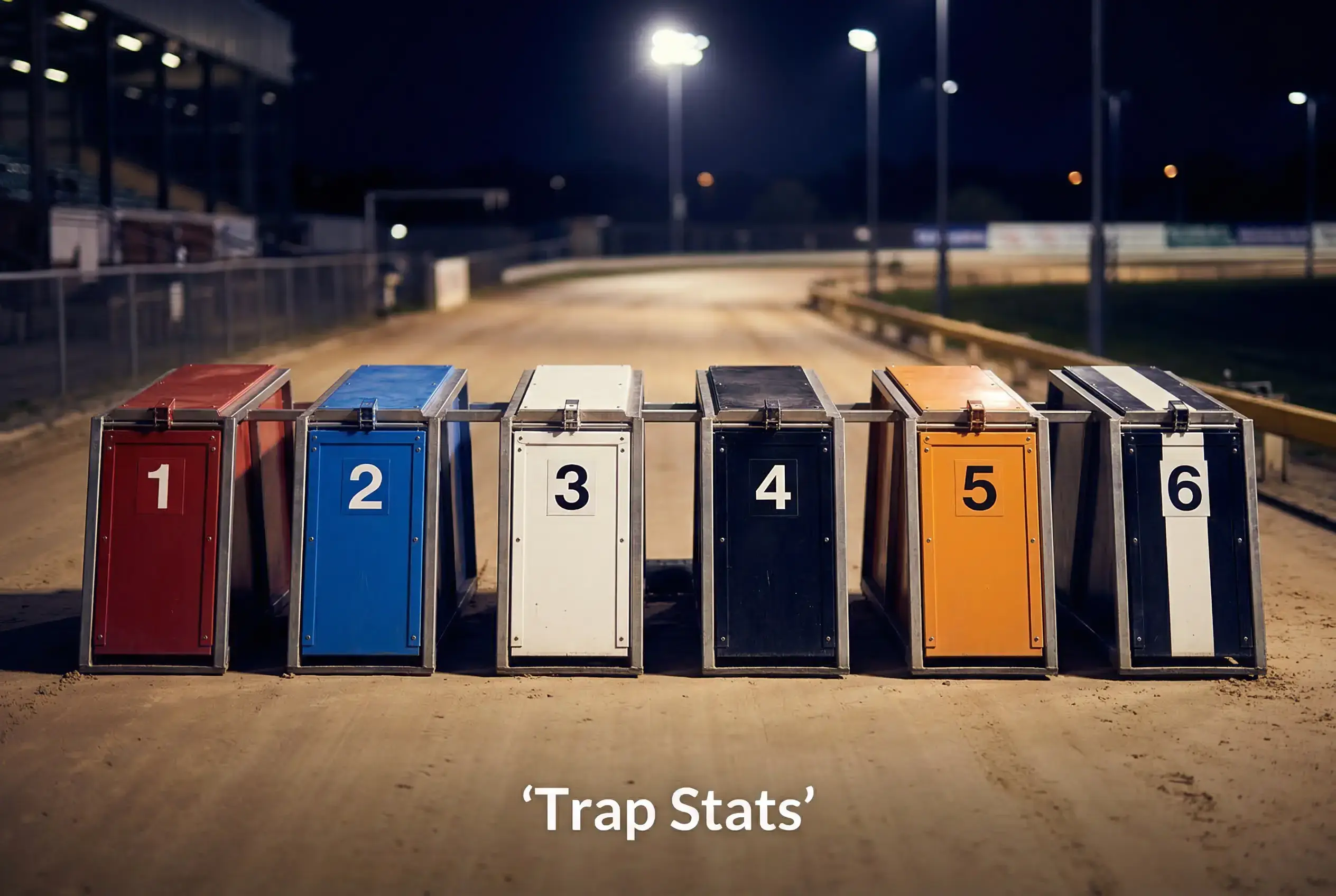
Trap Bias at Newcastle: Why Starting Position Shapes the Result
In greyhound racing, the trap draw is never neutral. Every track in the country has a measurable bias towards certain starting positions, and Newcastle is no exception. The shape of the bends, the length of the run-up to the first turn, the surface, and even the hare system all conspire to give some traps a statistical advantage over others. For anyone serious about reading Newcastle greyhound trap stats, understanding this bias is not a nice-to-have — it is the starting point of any credible form analysis.
Consider a parallel from another track to illustrate the point. At Hove, data drawn from over 2,800 races shows that trap one wins 19.9% of all races while trap five manages just 13.6%. In a perfectly balanced six-trap field, each position would win roughly 16.7% of the time. The gap between the best and worst traps at Hove is more than six percentage points — a colossal difference in a sport where margins are measured in lengths and fractions of a second. Newcastle has its own version of this pattern, shaped by Brough Park’s specific dimensions and track characteristics.
This guide breaks down the Newcastle greyhound trap stats in detail: overall win percentages, how those numbers shift across different distances, and — most importantly — how to combine trap data with form, going conditions and race type to build a fuller picture. Numbers alone tell you what has happened. Understanding why it has happened, and when the numbers might lie, is what separates a data-literate punter from someone who just backs the inside box every time.
See also: newcastle greyhound results — your source for Newcastle greyhound info.
What Is Trap Bias and Why Does Every Track Have One
Trap bias is the tendency for certain starting positions to produce more winners than others at a given track. It is not a quirk or a fluke — it is a structural feature of every greyhound circuit in the world, produced by the physical relationship between the starting boxes and the first bend.
The mechanics are straightforward. Greyhounds break from six traps numbered one (closest to the inside rail) through six (furthest from the rail). The first bend arrives within seconds of the start, and when six dogs travelling at 40-plus miles per hour converge on a single piece of curved track, geometry takes over. The dog on the inside has the shortest path around the bend. The dog on the outside has to cover more ground unless it possesses enough early pace to cross the field and seize the rail before the turn. In between, dogs in traps two through five must navigate varying degrees of traffic.
This is why every track has some form of trap bias. The magnitude varies — tighter tracks with shorter run-ups exaggerate the advantage of inside boxes, while larger circuits with longer straights before the first bend reduce it. But the advantage never disappears completely. Even on the fairest tracks, trap one will win more often than trap six over a large enough sample.
What makes trap bias useful rather than just interesting is the variation between tracks. A greyhound that routinely wins from trap five at a large, open circuit might struggle from the same position at a tighter track where the inside rail is king. If you are comparing form from one venue to another — say, assessing a greyhound running at Newcastle for the first time after a string of results at Romford — you need to factor in the different trap biases. A trap-five winner at Romford is not the same proposition as a trap-five runner at Brough Park. The numbers are track-specific, and applying them correctly requires knowing what each track’s data actually says.
It is also worth noting what trap bias does not tell you. It does not guarantee that the inside trap will win any individual race. It does not account for the quality of the dog in each trap, or the pace of the break, or the going conditions on the night. Trap bias is a statistical tendency observed across hundreds or thousands of races. It tells you that, all else being equal, certain positions have a structural edge. The art is knowing when all else is not equal — and adjusting accordingly.
Newcastle Trap Win Percentages by Distance
The most useful trap data for Newcastle comes from GreyhoundStats.co.uk, which publishes current-year statistics broken down by track, distance and race type. For 2026 data, this remains the most comprehensive publicly available source for Newcastle greyhound trap stats, and it is updated continuously as new results feed through.
Across all distances combined, the overall pattern at Newcastle follows the industry norm: traps one and two tend to produce the highest win rates, traps five and six the lowest. But the aggregate numbers mask significant variation at the distance level, and it is the distance-specific data that tells the real story.
Over 480 metres — the standard trip and the distance that produces the largest sample size — the inside traps hold an advantage, but it is less extreme than at some tighter circuits. Trap one at Newcastle over 480 metres typically wins at a rate somewhere in the upper teens as a percentage, while trap six sits in the low-to-mid teens. The gap exists, but it is not so large that it overwhelms other factors like early pace, form, and greyhound quality. This is consistent with Newcastle’s 415-metre circumference, which provides a reasonable run-up to the first bend and gives middle and outside runners at least a fighting chance to find position before the track narrows.
The sprint distances tell a different story. Over 290 metres, the trap bias intensifies significantly. With the first bend arriving almost immediately after the start, inside traps carry a disproportionate edge. Trap one’s win rate over 290 metres at Newcastle runs higher than its overall average, and trap six drops further below the mean. The maths is simple: there is less time and space for an outside runner to cross the field before the bend compresses the pack, so the structural advantage of the inside rail is amplified.
At the 680-metre distance, the pattern softens in the other direction. The extra yardage means greyhounds negotiate additional bends and have more time to recover from a poor start or an unfavourable draw. Outside traps are not suddenly favoured — trap one still tends to lead the win-rate table — but the differential between the best and worst traps narrows. Staying races are decided more by stamina, pace judgement and racing luck over multiple bends than by the initial scramble at the first turn.
One important caveat about the Newcastle data: sample sizes matter. The 480-metre trip produces hundreds of races per year, which gives you a statistically meaningful dataset. Sprint and staying distances produce far fewer races, and the trap percentages from those distances are more volatile. A handful of results in either direction can swing the numbers significantly. When working with trap stats for 290-metre or 680-metre races at Newcastle, treat the figures as indicative rather than definitive, and cross-reference them against at least two or three months of data before drawing firm conclusions.
The Hove comparison referenced earlier — where trap one wins 19.9% and trap five just 13.6% — provides a useful benchmark. Newcastle’s bias is not identical to Hove’s, and the difference matters. Hove is a 425-metre track with its own bend geometry, hare system and surface. Applying Hove’s trap percentages to Newcastle would be like using London weather to plan an afternoon in Byker. The principle — that inside traps win more often — holds universally. The specific numbers do not.
How Trap Bias Changes Across 290m, 480m and 680m Races
The numbers outlined above describe what happens. This section is about what to do with that information when you are actually assessing a race card at Brough Park.
Start with the sprints. At 290 metres, the trap draw is the single most important variable after the quality of the greyhound itself. A well-drawn inside runner facing a slightly better-graded dog in trap five or six has a genuine structural edge that can offset the quality gap. The practical implication is clear: in evenly matched sprint fields at Newcastle, the inside trap should carry more weight in your analysis than form, recent times, or trainer patterns. That does not mean blindly backing trap one every time — a genuinely fast breaker from an outside box will occasionally burn the field before the first bend arrives. But across a season’s worth of sprints, the inside positions win at a rate that demands respect. If you are betting Newcastle sprints and not factoring the trap draw as your primary filter, you are working with one hand tied behind your back.
The 480-metre distance is where the punter’s job gets interesting. The trap data shows a gradient — inside better than outside — but the gradient is gentle enough that it can be overridden by other factors. A strong, clean breaker from trap four is not significantly disadvantaged compared to a moderate trapper from trap one. This is the distance where combining trap stats with sectional times, recent run style, and the going allowance pays the biggest dividends. The bias is real but not overwhelming, which means the other variables in your assessment — the ones that require actual judgement rather than just reading a table — carry proportionally more weight. Think of the trap data at 480 metres as a tie-breaker between two dogs you rate equally, not as a verdict that overrules the form book.
Staying races over 680 metres require a different mindset entirely. The extra yardage creates enough racing time for greyhounds to recover from poor positions, and the stamina demands of the longer trip mean that many front-running inside-trap dogs cannot hold their positional advantage to the finish. When assessing a 680-metre race at Newcastle, prioritise the dog’s staying record, recent fitness indicators, and how it handles multiple bends under sustained pressure. The trap draw matters — an inside berth is still preferable — but it sits lower in the hierarchy of factors than it does at any other distance. A punter who backs the inside trap in a staying race because the sprint data told them it was the strong position is applying the right principle at the wrong distance.
One further point about applying trap data across distances: watch for dogs switching trips. A greyhound that has been running over 480 metres and steps up to 680 may find that its usual inside-trap advantage counts for less, while a sprinter dropping back to 290 from 480 may suddenly benefit from a trap draw that was neutral at the longer distance. Distance changes reshuffle the trap hierarchy, and a flexible approach — one that adjusts the weighting of the trap data depending on the trip — will serve you better than a rigid formula applied uniformly across the card.
Rails, Middle and Wide: Reading Trap Bias for Newcastle
Beyond the raw win percentages, there is a more practical way to think about trap bias at Newcastle: the rail-middle-wide framework. This groups the six traps into three zones based on running position and gives you a quick mental model for assessing any race at Brough Park.
Traps one and two are the rail positions. Dogs drawn here are expected to hug the inside rail from the start, taking the shortest possible route around the bends. At Newcastle, these two traps collectively produce the highest win rate of any zone. A greyhound in trap one or two that breaks cleanly has the geometry in its favour — fewer metres to cover, less risk of interference on the first bend, and a straightforward racing line. The ideal railer is a dog that breaks sharply, finds the rail within the first stride, and does not get drawn wide by traffic. Form figures showing “Rls” (rails) in the running comments are a positive signal for greyhounds drawn on the inside at Brough Park.
Traps three and four occupy the middle. Dogs drawn here face a decision point at every start: do they try to cut inside and find the rail, or do they commit to a wider racing line and hope their pace carries them through? The best middle-trap runners at Newcastle are those with enough early speed to find a gap on the rail before the first bend arrives, or those with enough tactical sense to sit behind the pace and pick up through the final straight. Middle traps are the hardest to assess from trap data alone because the outcome depends so heavily on how the individual dog runs. Two greyhounds in trap three can have completely different experiences in the same race — one finds the rail and travels, the other gets squeezed wide and wastes lengths on the bend.
Traps five and six are the wide positions. At Newcastle, these traps face the structural disadvantage that exists at almost every track: more ground to cover, more traffic to negotiate, and less room to find the rail before the first bend. The data bears this out — traps five and six consistently produce the lowest win rates at Brough Park across all distances. But “lowest” does not mean “zero.” Greyhounds drawn wide can and do win, especially if they have explosive early pace or if the inside runners interfere with each other in the early stages. A wide-running dog that has a clear run on the outside of the field can sometimes use its extra momentum to lead into the second bend, and from there the wider draw becomes irrelevant.
The rail-middle-wide framework is deliberately simple, and that is its value. It gives you an instant read on whether a greyhound’s draw is working for it or against it, and it helps you compare trap positions across different races on the same card without memorising exact percentages for each box. When you are standing at the rail at Brough Park with a racecard in one hand and a pint in the other, “inside good, middle variable, outside tough” is a more useful heuristic than a spreadsheet. The spreadsheet helps you later. The framework helps you now.
Combining Trap Stats with Form and Going Conditions
Trap stats in isolation are a blunt instrument. They tell you what tends to happen at a given track, but they say nothing about the specific dogs in a specific race on a specific night. The real skill is combining trap data with form analysis and going conditions to build a layered assessment that accounts for all three dimensions.
Start with form. A greyhound’s recent results — its finishing positions, sectional times, running comments and trajectory — provide a picture of current ability that no amount of trap data can replace. If the best dog in the race is drawn in trap six, the trap disadvantage exists but may not be enough to stop it winning. If the weakest dog in the race is drawn in trap one, the structural edge of the inside rail will not turn a slow greyhound into a fast one. Trap data adjusts probabilities; it does not override class.
Next, factor in the going. Newcastle runs on a sand surface, and conditions vary from meeting to meeting. On a quick-running surface declared “Normal,” early pace is at a premium and the first bend tends to sort the field decisively. This amplifies trap bias because the race is effectively decided in the first few seconds. On a slower surface — whether due to rain, temperature or wear — the pace of the race drops, the field stays closer together for longer, and dogs drawn wide have marginally more time to recover from an imperfect start. Going conditions do not eliminate trap bias, but they modulate it. On a heavy night, a dog in trap five is slightly less disadvantaged than on a fast track where the inside rail is the only express lane to the first bend.
“They were legends of the track here at Newcastle,” Ian Walton, General Manager of Newcastle Stadium, said in late 2025, speaking about veteran trainers being honoured on All England Cup final night. That local knowledge — the kind accumulated over decades of watching races at Brough Park — is exactly the intangible factor that raw trap data cannot capture. Experienced Newcastle regulars know which trainers place their dogs tactically, which greyhounds handle the Brough Park bends better than their form at other tracks would suggest, and which conditions favour which running styles. The data provides the scaffolding. Local insight provides the finishing touches.
A practical approach for someone working with Newcastle trap stats for the first time: use the data as a filter, not a verdict. Check the trap win percentages for the distance being raced. If a greyhound you fancy on form is drawn on the inside, the data is supporting your selection. If it is drawn wide, the data is introducing a note of caution. Neither scenario is conclusive. The best assessments come from treating trap stats, form, and going conditions as three legs of the same stool — remove any one, and the whole thing tips.
Where to Find Updated Newcastle Trap Data
The most reliable source for current Newcastle trap statistics is GreyhoundStats.co.uk. The site publishes trap win percentages for every GBGB-licensed track — all 18 currently operating stadia — broken down by distance and race type, and updates its data as new results are processed. For Newcastle specifically, you can filter by graded races, open races, or all race types combined, and view the numbers for each distance individually. It is free to access and does not require registration.
Explore Newcastle greyhound 480m results.
GreyhoundStats is the go-to resource for a reason: it draws directly from official results and presents the data in a clear, filterable format. But it is not the only source worth consulting. The Racing Post’s greyhound section publishes form cards and race results that include trap positions, and over time you can build your own dataset by tracking results manually. Some punters prefer this approach because it forces them to engage with the data rather than passively consuming someone else’s summary. Building your own spreadsheet of Newcastle trap results, even if it covers just a few months, gives you a more intimate understanding of the patterns than any third-party website can provide.
A word of caution about data currency. Trap statistics are most useful when they are drawn from a recent and relevant sample. The numbers from three years ago may not accurately reflect the current bias at Brough Park if the track surface has been regraded, the hare system adjusted, or the mix of race distances on the card has changed. For this reason, it is worth prioritising current-year data — the 2026 figures from GreyhoundStats, for example — and supplementing that with longer-term trends rather than relying on historical numbers alone. The question is always the same: does the data reflect the track as it runs today?
Finally, bear in mind that trap data is a public resource. Every serious greyhound punter has access to the same numbers. The edge does not come from knowing the trap win percentages — it comes from interpreting them in context. Knowing that trap one wins 18% of 480-metre races at Newcastle is information. Knowing that the dog in trap one tonight is a known slow starter running on a surface that is going soft in the rain — that is analysis. The data gets you to the starting line. What you do with it from there is the part that matters.
