 Available in US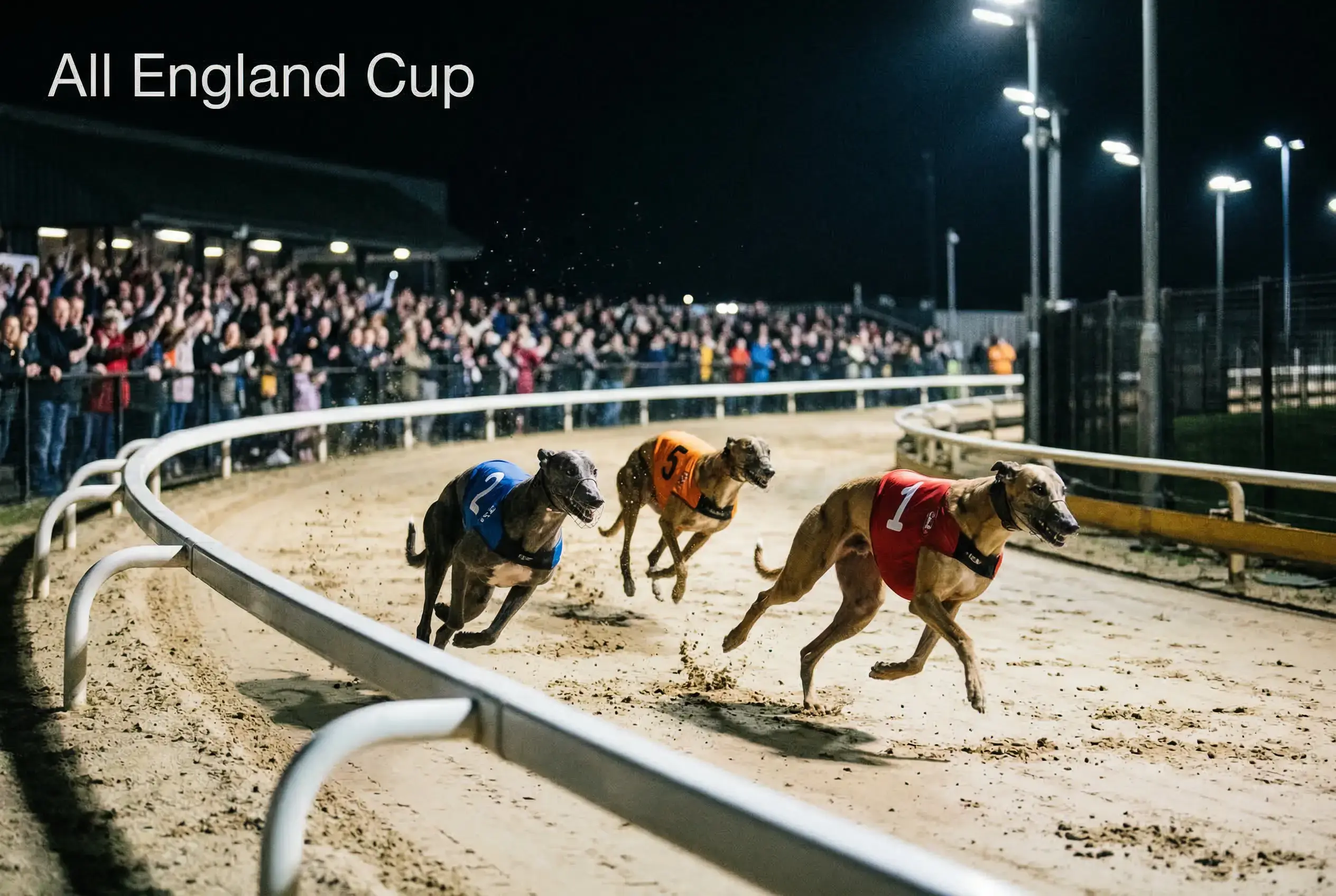
The All England Cup: Newcastle’s Premier Greyhound Event Since 1938
Most greyhound tracks have a weekly rhythm — graded races, BAGS meetings, the occasional open event that livens up an otherwise routine card. Newcastle has all of that, but it also has something most northern tracks do not: a genuine piece of the sport’s elite calendar. The All England Cup at Newcastle is a Category 1 event under the Premier Greyhound Racing banner, carrying a winner’s purse of £20,000 and a history that stretches back to 1938. It is the race that puts Brough Park on the national map.
The Cup is not just a local affair. It draws entries from across England, brings trainers and greyhounds up from the Midlands and the South, and generates the kind of atmosphere that regular Tuesday-night racing cannot match. For the Newcastle circuit, it is the annual showcase — the night when the spotlight falls on Byker and the wider greyhound world pays attention. For the sport as a whole, it is one of a shrinking number of premium open events that still command serious prize money and genuine prestige.
This article traces the All England Cup at Newcastle from its origins in the years before the Second World War, through its evolution into a modern Premier event, to the recent finals that have produced some of the most exciting racing Brough Park has seen. Along the way, we will cover the other major events on Newcastle’s calendar — the Northern Flat, the Northern Puppy Derby and the Trainers Championship — and look at what the sport’s centenary year in 2026 might mean for the track’s future.
See also: newcastle greyhound results — your Newcastle greyhound racing reference.
How the All England Cup Began at Brough Park
Brough Park opened its doors on 23 June 1928, making it one of the earliest purpose-built greyhound stadiums in the North of England. The first race that evening was won by a dog named Marvin at odds of 3/1 — a detail that survives in the historical record largely because it was the opening night of a venue that would go on to host racing for nearly a century. The stadium established itself quickly as the home of greyhound racing in the North East, drawing crowds from across Tyneside in an era when the dogs were one of the most accessible forms of live entertainment available to working-class communities.
A decade later, in 1938, the All England Cup was inaugurated at Brough Park. The timing was significant. By the late 1930s, greyhound racing had exploded in popularity across Britain, and major tracks were competing to establish their own flagship events. London had the Greyhound Derby at White City. Wimbledon had the Laurels. The All England Cup gave Newcastle a premier event of its own — one that drew entries from across the country and positioned Brough Park as more than just a regional circuit.
The early years of the Cup were interrupted by the Second World War, when racing continued on a reduced schedule but the sport’s calendar was disrupted. After the war, greyhound racing entered a boom period. Attendances across the UK reached record levels in the late 1940s and early 1950s, and the All England Cup became firmly established as one of the most prestigious open events outside London. The 1946 running of the Cup produced a moment that will never be repeated: the winners of the English, Irish, Scottish and Welsh Greyhound Derbies all lined up in the same competition, with English Derby champion Mondays News and Scottish champion Lattin Pearl finishing first and second in the final. That calibre of entry cemented the Cup’s reputation as a nationally significant event.
What made the All England Cup endure when so many other events from that era have disappeared is partly geography and partly stubbornness. Newcastle is the furthest north of any GBGB-licensed track with a Category 1 event, and the Cup has always served a dual purpose: a sporting competition in its own right and a declaration that elite greyhound racing is not confined to the South of England. That identity has kept the event relevant through decades of change — ownership transfers, track resurfacing, the shift from crowds in the thousands to crowds in the hundreds — because the event is bound up with the track’s sense of itself.
Race Format, Qualifying Rounds and Prize Money
The All England Cup runs as a knockout competition over several weeks. Greyhounds enter through qualifying heats, with the fastest qualifiers progressing through quarter-finals and semi-finals before the six-runner final. The entire competition takes place at Brough Park over the standard 480-metre distance, so the event is a test of speed, consistency and adaptability at Newcastle specifically — not a neutral-venue affair where track knowledge counts for nothing.
Entries are open to licensed greyhounds from any GBGB-registered trainer, which means the field includes both local Newcastle dogs and travelling entries from kennels across England. That mix is what makes the Cup distinctive. A heat might feature a locally graded greyhound that runs at Brough Park every week alongside a high-class open-race specialist from a southern track making its first appearance in Byker. The local dog knows the bends, the surface and the hare. The visitor may have a higher rating and a faster calculated time. How those advantages play off against each other is part of the drama.
The prize money is substantial by greyhound racing standards. The winner receives £20,000, with payments down through the places. That figure places the All England Cup among the most valuable open events outside the Greyhound Derby and the handful of other Category 1 competitions scattered across the calendar. For many trainers — especially those based in the North — the Cup represents the biggest single payday available to them without travelling to the Midlands or London. The prize structure is funded in part through Premier Greyhound Racing, the commercial arm that oversees elite events across the GBGB circuit.
The qualifying process also shapes the betting market. After the first round of heats, punters have actual Newcastle form to work with — times at the track, trap performance on the Brough Park bends, and running comments that are specific to this circuit rather than transferred from elsewhere. The market tends to tighten as the competition progresses and the evidence base grows. By the semi-final stage, there are usually fewer surprises, and the final is often dominated by dogs that have proven their ability at Newcastle across multiple rounds. That does not make the final predictable — six greyhounds running at close to their maximum over 480 metres always produces tight finishes — but it does mean the form book is more reliable by the time the Cup reaches its conclusion.
Recent All England Cup Winners and Memorable Finals
The most recent All England Cup winner to generate national headlines was Wicky Ned, trained by Newcastle-based Jimmy Fenwick. Wicky Ned won the Cup in 2024 and then went on to claim the Northern Flat at Brough Park the same year — a double that established the greyhound as the dominant dog at the track. The GBGB subsequently named Wicky Ned Greyhound of the Year for 2024, the first time a Newcastle-trained dog had claimed that award in the modern era. It was a moment of genuine significance for the Newcastle circuit, and Fenwick’s response captured the ambition it generated: “I think we’ve got a good team over here just now to have a go at beating the Irish,” he said, referring to the Irish dominance of the English Greyhound Derby, the sport’s most prestigious event.
Wicky Ned’s Cup win was not just a good result — it was a statement that Brough Park could produce greyhounds capable of competing at the very top. For years, the northern circuit had been seen as a tier below the powerhouse tracks in the Midlands and South. Fenwick’s operation, built around local knowledge and a steady supply of well-prepared dogs, challenged that assumption in the most emphatic way possible.
The 2025 All England Cup final drew the largest crowd of any race night at Newcastle that year, with footfall up 85% compared to the previous year’s final according to Arena Racing Company’s own figures. That surge in attendance reflected broader trends — ARC had been investing in the matchday experience across its greyhound portfolio — but the Cup final was the catalyst. People came because the event mattered, and they came in numbers that vindicated the investment in keeping a Category 1 competition at a northern venue.
The pattern of recent finals shows the competition working as intended: a mix of local and travelling runners, competitive fields, and results that are not foregone conclusions. The finals produce stories — underdogs from the heats running the race of their lives, fancied dogs getting caught on the first bend, and calculated times that rival anything produced at the bigger southern tracks. The Cup is at its best when it generates the unexpected, and the format of qualifying rounds followed by a single-race final ensures that anything can happen on the night.
What separates the All England Cup from lower-profile open races is the stakes — not just the money, but what a win represents. For a northern trainer, taking the Cup is proof of concept: evidence that a kennel based in the North East, working with the same bloodlines and facilities available to everyone else, can produce a greyhound good enough to beat the best in the country over 480 metres on its home track. For travelling entries from southern and Midlands kennels, winning the Cup means conquering an unfamiliar surface, unfamiliar bends and a crowd that is not entirely on their side. Both narratives give the final an edge that routine open races lack.
Northern Flat, Northern Puppy Derby and the Trainers Championship
The All England Cup is the headline act, but Newcastle’s events calendar runs deeper than a single competition. The Northern Flat, the Northern Puppy Derby and the Trainers Championship all take place at Brough Park, and between them they ensure that the track hosts meaningful open-race action across multiple months of the year.
The Northern Flat is a 480-metre open event that carries a winner’s prize of £12,500. It sits a step below the All England Cup in terms of prestige but attracts strong fields in its own right, drawing entries from across the GBGB circuit. The Northern Flat typically runs on a different part of the calendar to the Cup, giving Newcastle two major open competitions at its standard distance rather than concentrating all its firepower into a single event. For trainers, the Northern Flat is an attractive target — the prize money is significant, the competition is serious, and the race is run over a distance and at a track that many of them know intimately.
The Northern Puppy Derby is Newcastle’s premier event for younger greyhounds. Restricted to dogs under a certain age, the Puppy Derby offers a prize of £12,500 to the winner and serves as a showcase for the next generation of racing talent. Puppy events are particularly interesting from a form perspective because the dogs are still developing — their running styles, their handling of bends, their consistency from race to race are all less established than in the senior ranks. A greyhound that wins the Northern Puppy Derby is making a statement about its potential, and trainers, owners and punters all pay close attention to the results.
The Trainers Championship operates on a different principle entirely. Rather than a single knockout competition, it is a season-long points-based event that rewards consistency across multiple meetings. Trainers accumulate points based on the results their greyhounds achieve at Newcastle over the course of the year, and the championship is awarded to the trainer with the highest total at the end of the qualifying period. This format incentivises trainers to maintain a strong, deep kennel of runners at Brough Park rather than concentrating on one or two star dogs. It is a professional’s competition — less glamorous than a Cup final, but arguably more revealing about which operations are genuinely producing results week in, week out.
Taken together, these events give Newcastle a calendar that rivals any track outside the very top tier. The total annual prize fund across all GBGB tracks exceeds £15.7 million, and Newcastle claims a meaningful share of that figure through its programme of open and feature races. For a track in the North East — far from the traditional centres of power in greyhound racing — that level of activity represents both an investment and a statement of intent.
The events also feed into each other. A greyhound that performs well in the Northern Puppy Derby might progress to the All England Cup a year later. A trainer who wins the Championship is likely to have runners in the Northern Flat. The calendar is not a collection of disconnected events — it is an ecosystem that rewards trainers who commit to Newcastle as their primary track and develop their dogs with Brough Park’s characteristics in mind.
Attending an All England Cup Final Night at Newcastle
An All England Cup final night at Brough Park is a different experience from a regular meeting. The crowd is bigger, the energy is sharper, and the quality of racing on the undercard — the support races that run alongside the Cup final — is typically higher than on an ordinary evening. It is the one night of the year when Newcastle Stadium feels like a genuinely major sporting venue rather than a local track going about its weekly business.
The 85% increase in footfall at the 2025 final was not an anomaly. ARC has been deliberately building the event atmosphere at its greyhound tracks, and the Cup final is the natural beneficiary. Hospitality packages are available for groups, the restaurant does a brisk trade, and the trackside areas fill up well before the first race. “They were legends of the track here at Newcastle,” Ian Walton, the stadium’s General Manager, said in late 2025, speaking about veteran trainers being honoured on Cup final night. The event has a way of pulling the Newcastle greyhound community together — regulars, occasional visitors and complete newcomers sharing the same patch of rail and the same anticipation.
For first-time visitors, the Cup final is arguably the best possible introduction to the sport. The racing is elite-level, the crowd creates an atmosphere that is absent from quieter midweek meetings, and the sense of occasion makes even the undercard races feel more significant. The practical advice is the same as for any Newcastle meeting — arrive early, buy a racecard, dress for the weather — but the experience is amplified. If you are going to visit Brough Park once, make it Cup final night.
The undercard deserves a mention in its own right. On Cup final night, the supporting races are typically stronger than a standard graded meeting, with the racing manager assembling fields that match the quality of the main event. This means the entire evening — not just the Cup final itself — provides a higher standard of competition than a regular fixture. Punters who arrive expecting to fill the early races with casual bets and save their focus for the final often find that the undercard is just as competitive and just as difficult to call.
ARC’s Racing Club Membership, launched at Newcastle in 2026, offers free admission and food-and-drink discounts that apply on Cup final night as well as regular meetings. For anyone who attends the Cup and wants to come back for more, the membership is a low-cost way to stay connected to the Newcastle racing scene throughout the year.
2026 Centenary: What It Means for Newcastle’s Calendar
Greyhound racing in the UK turns 100 in 2026. The first regulated race under rules took place on 24 July 1926 at Belle Vue in Manchester, and the GBGB has designated 2026 as a centenary year with a programme of celebrations planned across the sport. For Newcastle, a track that has been part of the story since 1928, the centenary is both a milestone and an opportunity.
Explore Newcastle greyhound track records.
The centenary programme is expected to include commemorative events at tracks across the country, a Track of the Year Award, and a formal anniversary dinner organised by the GBGB. Newcastle’s involvement is assured given its status as one of the oldest continuously operating stadiums in the sport and the only northern track with a full slate of Category 1 events. The All England Cup will almost certainly carry additional significance in its centenary-year edition, with the GBGB and ARC both motivated to use the occasion to generate attention for a sport that has spent much of the past decade fighting for visibility.
For the track’s calendar specifically, the centenary creates an opportunity to attract casual and lapsed racegoers who might be drawn by the historical angle. Greyhound racing’s history in Britain is rich and under-told — the post-war crowds of 50,000 at White City, the working-class culture that built the sport, the decades of decline and survival that brought it to its current state. Newcastle’s own history, from the opening night in 1928 through the William Hill era and the ARC acquisition in 2017, is part of that larger narrative. A centenary is the kind of hook that can reach beyond the core audience and bring new people through the gates.
Whether the centenary translates into lasting change or remains a one-year publicity exercise will depend on what the sport does with the attention. Newcastle is better positioned than most tracks to capitalise on it — the All England Cup provides a natural centrepiece event, the ARC Racing Club Membership programme offers a path from first visit to regular attendance, and the track’s recent investment in the matchday experience gives newcomers a reason to come back.
The wider context matters too. Greyhound racing in Britain faces genuine headwinds — declining betting turnover, a proposed ban in Wales, and a shrinking number of licensed stadia. The centenary arrives at a moment when the sport needs to articulate a case for its future, not just celebrate its past. For Newcastle, the case is straightforward: the track produces elite racing, draws growing crowds to its flagship events, and offers an experience that connects people to a tradition nearly a century old. The centenary is a starting gun, not a finish line. What Newcastle and the sport do with the next twelve months will determine whether 2026 is remembered as a turning point or just a number on the calendar.
