
 Available in US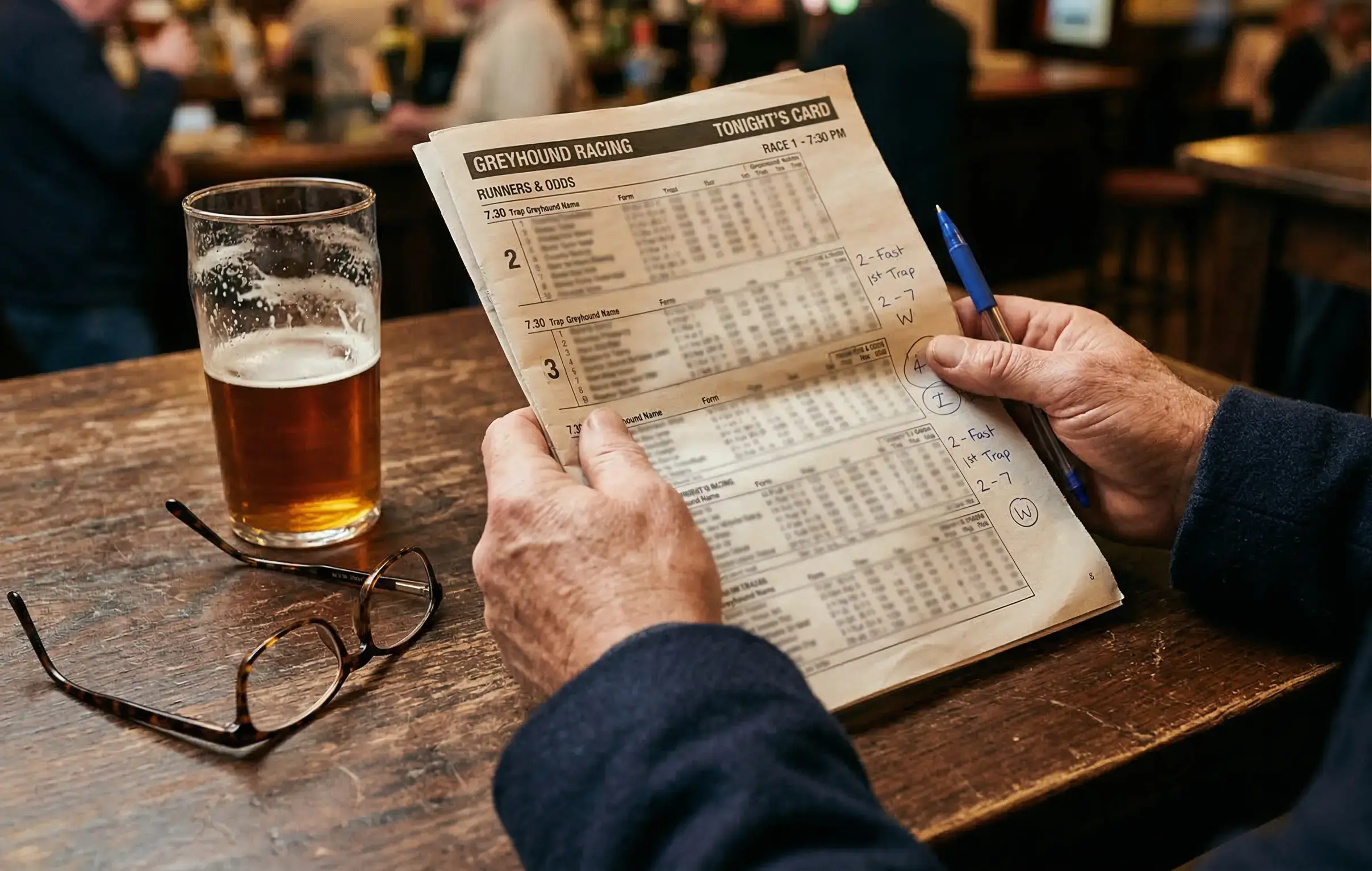
Decoding a Newcastle Racecard: Every Field, Every Abbreviation
A greyhound racecard looks like a wall of numbers and abbreviations the first time you hold one. Trap numbers, form strings, calculated times, trainer names, running comments compressed into two-letter codes — it can feel like someone handed you a spreadsheet in a foreign language and expected you to place a bet on it. The good news is that the language is learnable, and once you crack it, a racecard becomes the single most useful tool at your disposal on any night at the dogs.
This guide explains how to read a Newcastle greyhound racecard from top to bottom. Every field, every abbreviation, every number that appears on a standard card at Brough Park gets a plain-English explanation here. We will work through the anatomy of the card, decode the form figures that track each greyhound’s recent history, translate the shorthand that race commentators use to describe how a dog ran, and explain the timing data that separates a useful racecard from a meaningless one.
Whether you are planning your first visit to Newcastle or you have been going for years and still skip over the bits you do not understand, this is the reference you keep coming back to. A racecard is not decoration. It is the difference between watching six dogs run and actually understanding what you are seeing.
See also: newcastle greyhound results — your complete guide to Newcastle greyhound racing.
Anatomy of a Newcastle Greyhound Racecard
Every racecard at Brough Park follows the same basic structure, whether you pick up a printed version at the entrance or view one online through a racing data provider. The card is organised by race — typically ten to twelve races per meeting — and each race entry contains a block of information for every greyhound in the field.
At the top of each race block, you will find the race number, the distance and the race grade. At Newcastle, distances range from 290 metres up to 895 metres, with the 480-metre trip appearing most frequently on a standard card. The grade tells you the level of competition: A1 is the highest graded level at the track, with higher numbers indicating lower-graded races. Open races, which attract entries from outside the Newcastle circuit, are marked separately and sit above the grading system entirely.
Below the race header, each greyhound is listed by trap number — one through six, colour-coded by convention (red for trap one, blue for two, white for three, black for four, orange for five, black-and-white stripes for six). Beside the trap number, you will see the greyhound’s name, its trainer, and a line of form figures that summarise recent race results. This form line is the most information-dense part of the card, and we will break it down in the next section.
Further along the entry, the card shows the greyhound’s best recent time over the distance being raced, its calculated time (an adjusted figure that accounts for going conditions), and sometimes a Timeform or sectional rating. Some cards also include the greyhound’s weight, age and colour, though these vary depending on the card provider. The weight in particular is worth noting — a greyhound that has gained or lost a pound or more since its last run may be in different physical condition, for better or worse.
At the bottom of each race entry, you may find additional notes from the racing manager or analyst — brief comments on the expected pace of the race, which dogs are fancied, or which runners face a step up or down in class. These notes are opinions rather than facts, but they can be useful context for anyone still building familiarity with the Newcastle card.
The structure is consistent from card to card. Once you know where each piece of information lives, you can scan a race entry in seconds and pick out the details that matter. The trick is knowing which details those are — which is what the rest of this guide addresses.
Reading Form Figures: What the Numbers and Letters Mean
The form line is the compressed history of a greyhound’s recent races. It reads from left to right, with the most recent result on the right-hand side. Each character in the sequence represents a single race, and the figure tells you where the dog finished. A form line of 3 2 1 4 1 1 means the greyhound finished third, then second, then first, then fourth, then two consecutive wins — reading chronologically from oldest on the left to newest on the right.
Numbers one through six correspond to finishing positions in a standard six-runner field. A “1” is a win. A “6” means the dog trailed home last. Simple enough. But the form line also includes letters that carry specific meanings, and these are where many newcomers get lost.
An “O” in the form line means the greyhound finished outside the first six — typically in a race with a reserve runner or in a situation where the official result placed the dog beyond the standard field. A “0” (zero) can appear in some card formats and means much the same thing. A dash or hyphen indicates a break in the dog’s racing — either a period of rest, injury, or a kennel transfer where there is a gap in its competitive record. When you see a dash, it is worth checking how long the break was. A two-week gap is routine. A three-month gap suggests injury or a spell out of training, and the dog returning from that kind of absence is not the same proposition as one that has been racing every week.
The letter “T” in a form line denotes a trial run — a solo time trial rather than a competitive race. Trials do not have finishing positions because the dog runs alone, but they do produce a time, and that time feeds into the calculated time on the card. Trials are common when a greyhound is returning from a layoff, switching to a new track, or being assessed over an unfamiliar distance. A form line ending in T tells you the dog has not raced competitively in its most recent outing, which is significant information.
Some form lines also include letters denoting the track at which each race was run. At Newcastle, the card will typically show “Ncl” for Brough Park results and abbreviations for other tracks where the greyhound has raced recently — “Snd” for Sunderland, “Don” for Doncaster, and so on. This matters because form earned at one track does not always transfer to another. A greyhound with a string of firsts at Sunderland may face different challenges at Newcastle, where the bends are slightly more open and the standard distances differ.
The form line is a snapshot, not a biography. It shows you the last six to eight runs, which might cover three weeks or three months depending on how frequently the dog has raced. Read it as a trend. Improving form — a line that moves from fives and fours to twos and ones — suggests a dog that is coming into peak condition. Declining form — ones becoming threes becoming fives — suggests the opposite. A consistent line of twos and threes tells you the dog is competitive but not quite winning, which is its own kind of useful information.
Full Glossary of Racecard Abbreviations (SAw, Crd, EP and More)
Running comments on a greyhound racecard are written in a compressed shorthand that describes how a dog ran during a race. These abbreviations appear in the detailed form section — often in a smaller font beneath the main form line — and they tell you far more about a greyhound’s racing style than the finishing position alone. Here are the ones you will encounter most frequently at Newcastle.
SAw stands for “slow away” — the greyhound was slow to leave the traps. This is one of the most important abbreviations on any card because a slow start can ruin a run regardless of the dog’s ability. If you see SAw appearing repeatedly in a greyhound’s recent form, that dog has a trapping problem, and the trap draw becomes even more critical. A slow trapper in an inside box might still recover; a slow trapper drawn wide is giving away ground it cannot afford to lose.
EP means “early pace” — the greyhound showed strong speed in the early stages of the race. This is the opposite end of the spectrum from SAw and tells you the dog breaks well and contests the lead from the start. Dogs with EP in their running comments are the ones that benefit most from inside trap draws because they can convert that early speed into a rail position before the first bend.
Crd stands for “crowded” — the greyhound was impeded by other dogs during the race, either on a bend or in the straight. Crowding is common in greyhound racing, especially at the first bend where six dogs converge, and a Crd comment partly excuses a poor finishing position. If a dog finishes fourth but the comments show “Crd 1st,” it was checked at the first bend and lost ground it might not have lost in a cleaner race.
Rls means “rails” — the greyhound raced on the inside rail. This tells you the dog had the shortest possible route around the bends, which is generally a positive sign. MsDis stands for “middle distance,” indicating the dog ran in the middle of the track, while W or Wide means it raced on the outside — covering more ground than dogs closer to the rail.
Other abbreviations you will see at Newcastle include Led (led the race or a portion of it), FinWl (finished well — strong run in the closing stages), RnOn (ran on — maintained pace to the line without fading), Bmp (bumped by another dog), Ck or Chkd (checked — forced to slow or change direction by interference), and Stb (stumbled). Each of these adds a layer of context to the raw finishing position.
The value of running comments lies in what they reveal about excuses and tendencies. A greyhound that finishes third but was SAw and Crd at the first bend is a different prospect from one that finished third with a clear run and simply was not fast enough. Similarly, a dog that consistently shows Led and FinWl is a front-runner that holds its position — a racing style that can be very effective from an inside trap at Brough Park. Learn to read the abbreviations and you stop seeing finishing positions as verdicts. You start seeing them as stories with context.
Calc Time, Winning Time and Sectional Times Explained
Timing data is where a racecard stops being a summary of opinions and starts being a source of measurable facts. Three types of time appear on a standard Newcastle greyhound racecard, and understanding the difference between them is essential for anyone who wants to go beyond casual form-reading.
The winning time is the simplest: it is the clock time of the race winner from the moment the traps open to the moment the first greyhound crosses the line. At Newcastle over 480 metres, a typical winning time sits in the range of 29 to 30 seconds, depending on the going. This number tells you exactly how fast the race was run, but on its own it is misleading because it does not account for the surface conditions on the night. A 29.40 on a fast track and a 29.40 on a slow track represent very different levels of performance.
That is where the calculated time — usually shown as “calc” on the card — comes in. The calc time adjusts the raw time for the going allowance, producing a standardised figure that can be compared across meetings. If the going on a particular evening is declared “slow two” (meaning the track is running two lengths slower than standard), the calc time subtracts the equivalent time from each greyhound’s raw finish. This gives you a like-for-like comparison between a dog that ran 29.60 on a slow night and one that ran 29.30 on a fast night. The calc time might reveal they are closer in ability than the raw numbers suggest — or further apart.
Sectional times — sometimes called splits — break the race into segments. At Newcastle, a 480-metre race is typically split into the time from the traps to the first bend and the time from the first bend to the finish, though the exact split points can vary depending on the timing system in use. Sectional times tell you how a race unfolded, not just how it ended. A greyhound that runs a fast first split and a slower second split is an early-pace dog that fades. One that runs a slow first split and a fast second is a closer — a dog that finishes strongly but may need a clean run early to have anything left for the finish.
For punters, sectional times are among the most valuable data on a racecard because they reveal running style in a way that finishing positions cannot. Two greyhounds might both finish second in separate races, but if one ran a fast-early, slow-late sectional profile and the other ran slow-early, fast-late, they are fundamentally different types of runner. That difference matters when you are trying to predict how they will fare in a new race with a different trap draw, a different field, and different going conditions. The raw result says they are equal. The sectional times say they are not.
Timeform Ratings and Analyst Verdicts: How Experts Assess Form
Beyond the raw data of form figures and times, many racecards include expert ratings and analyst opinions. The most widely recognised are Timeform ratings — numerical assessments of a greyhound’s ability based on its performances, adjusted for factors like the quality of opposition and track conditions. A higher Timeform rating indicates a better greyhound, and the ratings can be compared directly across different tracks and distances.
Timeform ratings work on a scale where each point represents a measurable difference in performance. A dog rated 85 is expected to beat a dog rated 80 over the same distance on the same track, all else being equal. The ratings are not static — they adjust as new race data comes in, so a greyhound on an improving trajectory will see its rating rise over successive runs, while one in declining form will drop. The usefulness of Timeform ratings lies in their objectivity: unlike tips or predictions, they are calculated from actual performance data rather than subjective judgment.
That said, ratings have limitations. They capture what a greyhound has done, not necessarily what it will do. A dog with a high Timeform rating that has not run for three weeks may return below its best. A dog with a modest rating that has been improving steadily may be about to post a career-best performance. Ratings are backward-looking by nature, and the most profitable insights in greyhound racing often come from identifying dogs that are about to outperform their rating rather than those that already have a high one.
The outgoing chair of the GBGB noted in 2025 that racing greyhounds now receive the highest standard of care and oversight in the sport’s history — a claim supported by data showing the injury rate across GBGB tracks fell to 1.07% in 2024, a record low. That commitment to standards extends beyond welfare and into how race data is recorded and published, which is what makes tools like Timeform ratings and official sectional times possible in the first place. Without accurate, consistently recorded data, none of the analysis described in this guide would be reliable.
Analyst verdicts — the brief written comments that appear on some racecards — are a different beast entirely. These are opinions from racing journalists or form analysts employed by the card provider, and they range from genuinely insightful to formulaic. The best analyst notes flag specific factors that the numbers might not capture: a greyhound that has been working well in trials, a trainer who is known for targeting specific race types, or a dog that handles the Brough Park bends unusually well. Take them as supplementary context rather than gospel. The best analysts are right more often than they are wrong, but they are still working with incomplete information — just like everyone else.
SP, BSP and Forecast Dividends on a Results Card
Once a race finishes, the results card adds a layer of information that the pre-race card does not have: prices. These figures tell you what the market thought of each greyhound’s chances and what successful bets paid out.
SP stands for “starting price” — the official odds of each greyhound at the moment the traps open. The SP is determined by the on-course bookmakers and represents the consensus of the betting market just before the race begins. A dog that goes off at 2/1 SP was considered to have roughly a one-in-three chance of winning. A dog at 8/1 was seen as an outsider. The SP is retrospective information — it tells you what the market expected, not what actually happened — but it is useful for assessing whether a result was a surprise or a predictable outcome. When a 6/1 shot wins, the market was partly wrong. When the 4/6 favourite wins, the market got it right.
BSP is the “Betfair Starting Price,” a figure derived from the Betfair exchange rather than from traditional bookmakers. The BSP often differs from the SP because the exchange market and the bookmaker market do not always agree. For punters who use exchanges, the BSP is the more relevant price. For casual racegoers, the SP on the results card is the standard reference point.
Forecast and tricast dividends appear below the finishing order on a results card. A forecast pays out if you correctly predict the first and second finishers in the right order. A tricast requires the first three in order. Because these bets are harder to land, the dividends are significantly larger — a forecast might pay £15 or £20 from a £1 stake, while a tricast can return well over £100 for an unlikely combination. The dividend shown on the results card is the official payout per £1 staked, and it reflects the difficulty of the prediction based on the market prices of the dogs involved.
These figures matter for context. Greyhound racing in the UK generates substantial prize money — the total annual prize fund across all GBGB tracks stands at over £15.7 million — and the betting market is the financial engine that keeps the sport running. Understanding what SP, BSP and forecast dividends mean on a results card is not just about following the money. It is about understanding how the market prices risk, and using that information to spot races where the market under- or over-estimated a particular dog.
Worked Example: Reading a Real Newcastle Race Result Line by Line
The best way to cement all of this is to walk through an example. Imagine you are looking at a result from a major race at Newcastle — say, a heat of the All England Cup, the track’s flagship open event with a winner’s prize of £20,000. The result card for one race might read something like this:
Race 7 — 480m, All England Cup Heat 2. 1st: Trap 1, 29.32 (calc 29.10), SP 5/4. 2nd: Trap 3, 29.47, SP 7/2. 3rd: Trap 6, 29.55, SP 4/1. Forecast: £8.40. Tricast: £42.70. Going: Normal.
Read our first time guide to Newcastle greyhounds.
Start with the basics. The race was over 480 metres — the standard distance. It was a heat of the All England Cup, so this is an open race featuring dogs that may have travelled from outside the Newcastle circuit. The going was declared Normal, meaning the sand surface was running at its standard pace with no adjustment needed.
The winner came from trap one — the inside rail — in a time of 29.32 seconds. The calculated time of 29.10 tells you the performance was stronger than the raw time suggests, likely because the going allowance on this particular night was slightly slow (the adjustment brought the calc time down). The SP of 5/4 means the winner was the market favourite, so this was a result the betting market largely anticipated. No shocks at the head of the field.
Second place went to trap three, just over a length behind the winner (the time gap of 0.15 seconds translates to roughly a length and a half at greyhound racing speeds). Third went to trap six — the widest draw — at a SP of 4/1, suggesting the market gave this dog a reasonable chance despite the wide draw. It finished less than a quarter of a second behind the runner-up, so the wide trap may have cost it a place rather than a realistic winning chance.
The forecast dividend of £8.40 tells you that correctly predicting the 1-3 combination paid £8.40 for every £1 staked. Not a huge payout, reflecting the relatively short-priced finishers. The tricast of £42.70 is more generous because including the third-place finisher in the correct order adds significant difficulty.
Now imagine the running comments for the winner read: EP, Rls, Led1. This tells you the dog showed early pace, raced on the rails, and led from the first bend. From trap one in an All England Cup heat, that is a textbook front-running performance — early speed from the inside box, the shortest route around every bend, and control of the race from start to finish. The calc time of 29.10 over 480 metres in an open event is a strong performance, and if you saw this dog entered in the next round, you would know it handles the Brough Park circuit well from an inside draw.
That is what a racecard tells you when you know how to read it. Not just who won, but how they won, why the market priced them the way it did, and what the time and running comments suggest about future performance. Every race at Newcastle generates this kind of data. The card puts it all in one place. Your job is to read it.
