
 Available in US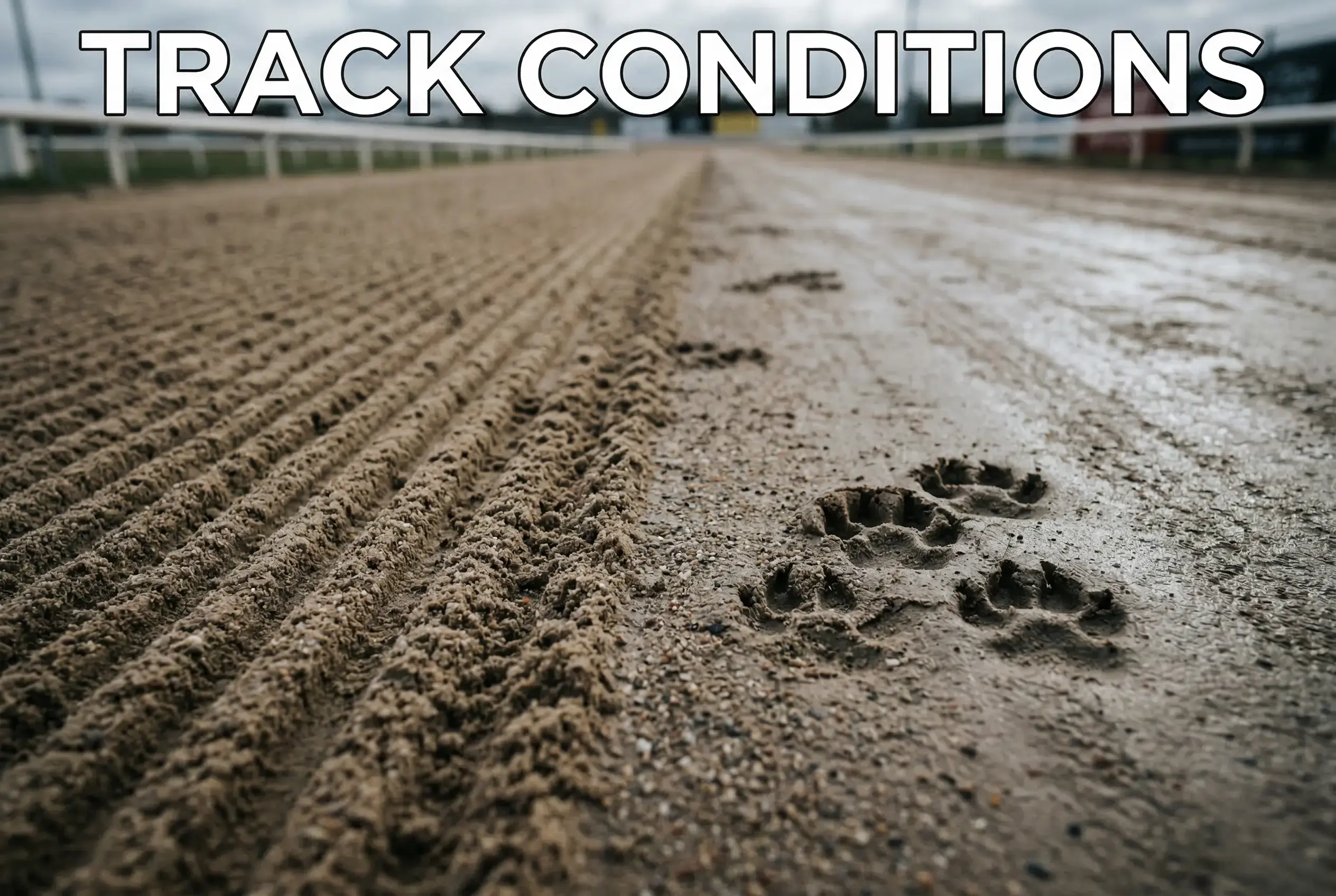
Why Going Conditions Matter More Than Most Punters Realise
A greyhound’s finishing time is not a fixed measure of ability. It shifts with the surface beneath its feet. Two runs at 480 metres by the same dog on the same track can produce times half a second apart — not because the dog ran differently, but because the going changed. At Newcastle, where racing takes place four days a week across every season, going and track conditions at Newcastle are a variable that touches every result on every card.
Most punters check the form. Fewer check the going. Those who do both have a structural advantage, because the going report for each meeting tells you how to interpret the numbers you are seeing. A fast time on fast going may be less impressive than a slightly slower time on slow going, and the dog that posted the slower time may actually be the stronger runner. Without the going as context, form figures are only half the story.
See also: newcastle greyhound results — your go-to Newcastle greyhound site.
Fast, Normal, Slow and Wet: What Each Going Means at Newcastle
Newcastle runs on a sand surface with a circumference of 415 metres. Sand is the most common surface in UK greyhound racing and behaves differently from the fibre-sand used at some other tracks. When the sand at Brough Park is dry and firmly packed, the going is classified as fast. Dogs get maximum traction, stride lengths are longer and finishing times are at their shortest. Fast going is generally considered the fairest test, because the surface is consistent and dogs can run to their natural speed without fighting the ground.
Normal going sits in the middle of the scale. The sand has absorbed some moisture — perhaps from light rain or overnight dew — but not enough to significantly alter the running surface. Times are fractionally slower than on fast going, and the difference is typically covered by the going allowance applied to calc times. Most meetings at Newcastle are run on normal going, making it the baseline against which other conditions are measured.
Slow going means the sand is holding more water than normal, usually after sustained rainfall. The surface becomes heavier, and dogs need more effort to maintain speed, particularly through the bends where the combination of centrifugal force and a softer surface can cause runners to lose their footing. Finishing times on slow going can be a full second or more slower than on fast going over 480 metres, and the character of the race changes: dogs with stamina and determination tend to outperform pure speed merchants, because the surface nullifies some of the advantage that raw pace provides on a firm track.
Wet going is the extreme end of the scale. Heavy or persistent rain can turn the sand surface into a surface that drags at the dogs’ feet, slowing times further and increasing the risk of slipping. At some point, if conditions deteriorate enough, the meeting is abandoned — the track management and racing manager make that call based on safety considerations. At Newcastle, abandonments due to weather are not common, but they do happen, particularly in the winter months when the North East weather is at its least cooperative.
Going Allowance and Calc Time: Adjusting Results for Conditions
The going allowance is a numerical adjustment applied to raw finishing times to produce a calculation time — the calc time — that strips out the effect of the going. If the going is slow and the allowance is set at +0.30, a raw finishing time of 30.10 becomes a calc time of 29.80. That calc time represents what the dog would have run under normal conditions, and it is the figure used for grading decisions, form comparisons and performance assessments.
The going allowance at Newcastle is determined before each meeting by the racing manager, based on trial runs conducted on the track before the first race. A greyhound runs over a measured section of the circuit, its time is compared to the expected benchmark, and the difference becomes the allowance. This process is repeated if conditions change during the meeting — if rain arrives mid-card, for instance, the allowance may be recalculated for the later races.
For punters, the calc time is the number that matters for form comparison. Comparing raw times across different meetings is misleading, because a 29.70 on fast going and a 30.00 on slow going may represent identical levels of performance once the allowance is applied. The calc time removes that ambiguity. When assessing Newcastle form, always look at the calc time column rather than the raw finishing time, especially if the meetings you are comparing were run on different going.
One caveat: the going allowance is an estimate, not a measurement. It is as accurate as the trial run and the racing manager’s judgement allow, but it cannot capture every nuance of how the surface played during every race. Two races on the same card may have been run on subtly different going if rain started between them, or if the track dried out during a gap. The allowance smooths these variations, but it does not eliminate them entirely. Treat calc times as the best available approximation, not as an absolute truth.
Track Maintenance, STRI Inspections and Greyhound Safety
The condition of the racing surface is not just a form variable — it is a safety issue. Greyhounds run at speeds exceeding 40 miles per hour, and any inconsistency in the surface — a divot, a patch of compacted sand, an area that drains poorly — can cause a stumble, a fall or an injury. Track maintenance at Newcastle involves regular regrading of the sand, attention to camber on the bends and monitoring of moisture levels across the circuit.
Explore Newcastle greyhound 480m results.
STRI — the Sports Turf Research Institute — conducts independent inspections of greyhound tracks on behalf of the GBGB. These inspections assess the surface quality, drainage, safety rails, hare rails and the overall condition of the racing environment. STRI reports are used by GBGB to determine whether a track meets the required standard for licensed racing. If significant issues are identified, the track must address them before the next scheduled meeting.
The link between track conditions and injury rates is documented. Across all GBGB-licensed tracks, the injury rate fell to a record low of 1.07% in 2024, with 3,809 injuries recorded from 355,682 individual runs. That figure represents the cumulative effect of improvements in track maintenance, veterinary oversight and welfare protocols across the sport. At Newcastle specifically, the sand surface is subject to the same maintenance regime and GBGB welfare monitoring as every other licensed track, and the condition of the going on any given night is both a performance variable and a reflection of how well the track is being maintained.
For punters, the safety dimension adds another reason to pay attention to the going report. A meeting run on going described as slow or wet is a meeting where the risk of interference, stumbles and unpredictable outcomes is slightly elevated. That does not mean you should avoid betting on such nights, but it does mean your confidence in form-based predictions should carry a wider margin of error. The going affects everything — not just times and results, but the reliability of the data itself.
