 Available in US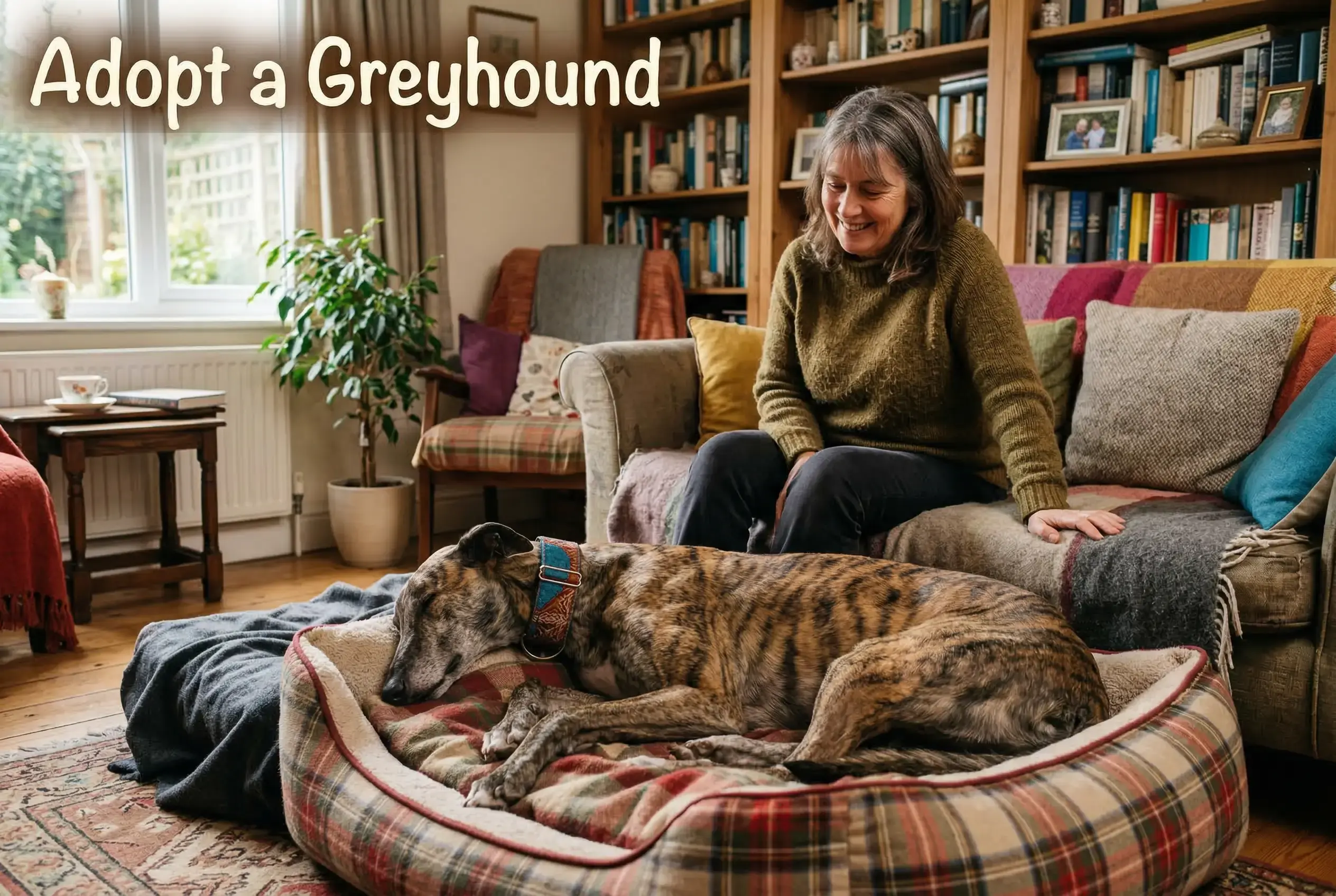
From Track to Sofa: How Retired Greyhounds Find Families
A racing greyhound’s career is short. Most dogs compete for two to four years before age, injury or declining form brings them to retirement. What happens next is the question that has shaped the welfare debate around greyhound racing more than any other single issue. In 2024, 94% of greyhounds leaving GBGB-licensed racing — 5,795 dogs in total — were successfully rehomed. That figure is the result of a rehoming infrastructure that has expanded significantly over the past decade, driven by public pressure, regulatory change and the work of dedicated organisations.
Greyhound rehoming after racing is not a single process. It is a network of charities, trusts, fosterers and private adopters that collectively absorb thousands of retired racers each year. The system works well for the majority of dogs, but it is not without gaps — and understanding how the process functions, from the moment a trainer declares a dog retired to the day it settles into a family home, is essential for anyone considering adoption or wanting to know what happens to the animals behind the results.
See also: newcastle greyhound results — your Newcastle greyhound portal.
The Rehoming Process: From Retirement to Adoption
The process begins with the trainer. When a greyhound is no longer competitive or is carrying a minor injury that makes continued racing impractical, the trainer notifies the track’s racing office that the dog is being retired. At GBGB-licensed tracks, this triggers a formal procedure: the dog’s retirement is recorded in the GBGB database, and the track’s welfare officer becomes involved in coordinating the next step.
For some dogs, the trainer arranges the rehoming directly. Trainers with established relationships with adopters or local rescue organisations may place a retired dog within days of its last race. For others, the dog enters the rehoming pipeline through the Greyhound Trust or another registered charity. The Trust assesses each dog’s temperament, health and socialisation needs before matching it with an appropriate home. Dogs that are not immediately suitable for a domestic environment — those that need dental work, are reactive to other animals or have never lived indoors — go through a preparation period before being listed for adoption.
The scale of the reduction in economic euthanasia tells part of the story. In 2018, 175 greyhounds were euthanised for economic reasons — meaning the owner or trainer chose to put the dog down rather than bear the cost of rehoming or ongoing care. By 2024, that number had fallen to three. The near-elimination of economic euthanasia reflects both regulatory pressure from the GBGB and the expansion of rehoming capacity across the network. It also reflects a shift in attitude: trainers who once saw euthanasia as a routine end-of-career option now face an industry that has explicitly declared the practice unacceptable.
The timeline from retirement to adoption varies. Some dogs are placed within a week. Others, particularly those with behavioural challenges or medical needs, may spend several months in foster care or a rehoming kennel. The Greyhound Trust and its branches manage this pipeline, but capacity is finite. During periods when a high number of dogs retire simultaneously — for example, at the end of a major competition cycle — the system can come under strain, and the speed of placement slows.
Key Rehoming Organisations and How They Work With Tracks
The Greyhound Trust is the largest and most established rehoming charity in the UK. It operates a network of branches that take in retired racers from tracks across the country, including Newcastle. Each branch runs its own fostering and adoption programme, assessing dogs on arrival and matching them with families based on the dog’s temperament and the adopter’s circumstances. The Trust also provides post-adoption support, recognising that the transition from kennel life to domestic life can take weeks or months.
Beyond the Greyhound Trust, a range of smaller organisations contribute to the rehoming effort. Greyhound Rescue Wales, Forever Hounds Trust and local breed-specific rescues all handle retired racers, often focusing on dogs with specific needs that the larger charities may not have capacity for. Some of these organisations work directly with trainers; others take referrals from the GBGB or from tracks where dogs have been surrendered.
The relationship between tracks and rehoming organisations is closer than it has ever been. Under the GBGB’s welfare strategy, tracks are required to have a clear retirement pathway for every dog that races at their venue. This means the racing office at Newcastle, for example, maintains contact with rehoming organisations in the North East and coordinates placements as part of the normal workflow of the track. The days of dogs falling off the radar after retirement — while not entirely eliminated — are significantly harder to sustain under the current regulatory framework.
What to Expect When Adopting a Retired Greyhound
Retired greyhounds are unlike most other dogs people encounter at rescue centres. They have spent their lives in kennels, trained to a strict routine, fed a high-performance diet and exercised in controlled environments. They may never have climbed stairs, encountered a cat, walked on a lead in a busy street or been left alone in a house. The adjustment period is real, and adopters who go in with realistic expectations tend to have the best outcomes.
Read about greyhound welfare in the UK.
The good news is that greyhounds are, by temperament, remarkably adaptable. Despite their speed on the track, they are famously lazy at home — the nickname “45-mph couch potato” exists for a reason. Most retired racers settle into a domestic routine within a few weeks, learning to navigate stairs, relax on furniture and coexist with other household pets. The Greyhound Trust provides guidance on the transition, including advice on diet, exercise, socialisation and muzzle training.
Prospective adopters go through a home check process, similar to that used by other rescue organisations. The check assesses whether the home is suitable for a greyhound — a secure garden, adequate space, no hazards — and whether the adopter understands the breed’s specific needs. Adoption fees vary by organisation but typically cover vaccinations, neutering, microchipping and dental work carried out before the dog is placed.
The demand for retired greyhounds as pets has grown steadily. Social media has played a role, with greyhound adoption accounts showcasing the breed’s gentle, photogenic nature to audiences that might never have considered a former racer. For anyone drawn to the idea of giving a retired athlete a second career as a household companion, greyhound rehoming after racing offers one of the most straightforward routes into dog ownership — and one of the most rewarding.
One aspect that adopters sometimes underestimate is the bond that develops. Racing greyhounds have spent their lives around people — trainers, kennel staff, racing officials — and they tend to be deeply sociable. The transition from kennel to home is not a rescue from neglect in most cases; it is a change of environment for a dog that already knows and trusts humans. That foundation makes the adjustment smoother than many adopters expect, and it is one reason why greyhound adoption has such a high success rate. The dogs are not damaged by their time on the track. They are simply ready for the next chapter.
