 Available in US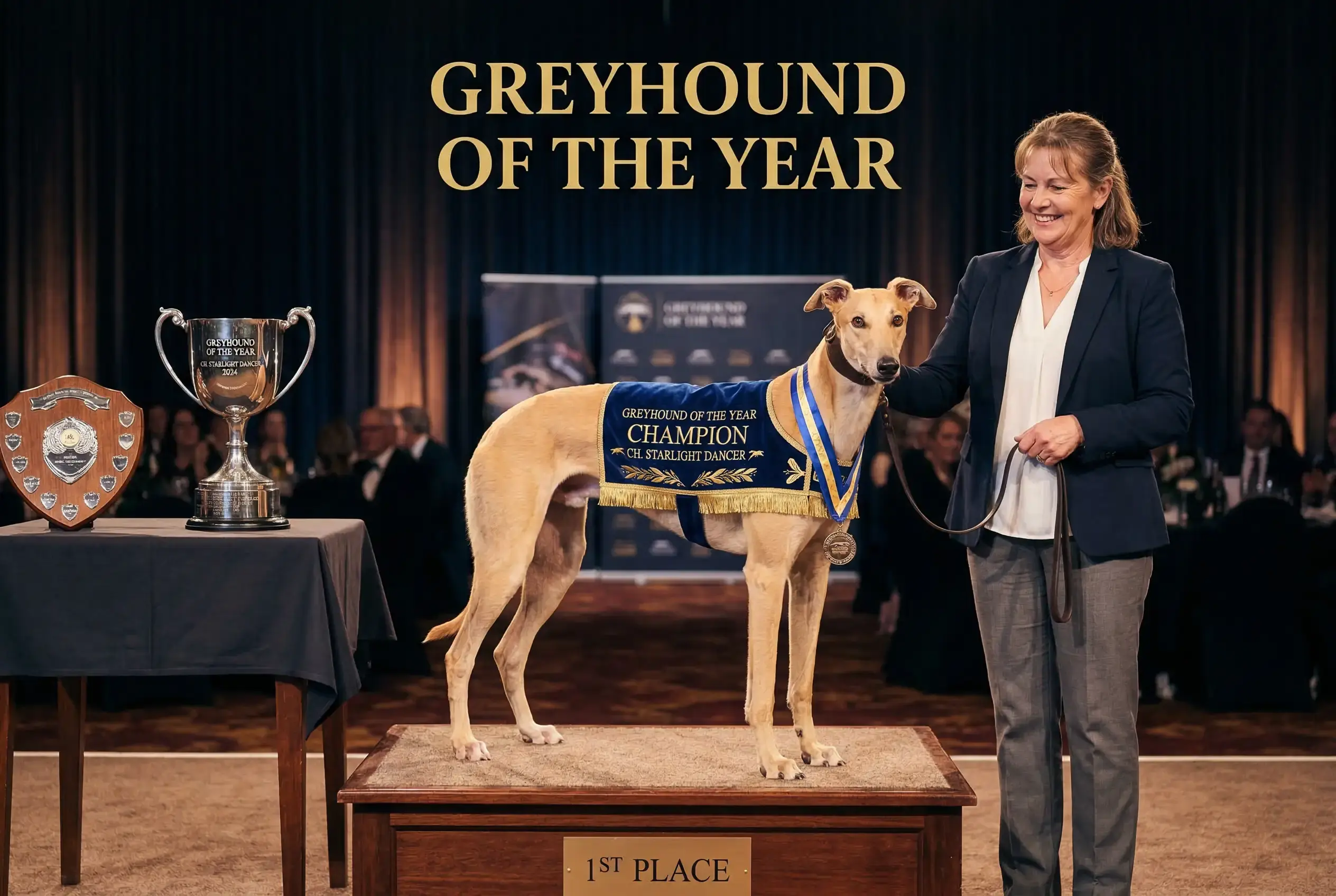
How a Newcastle-Trained Dog Became Greyhound of the Year
The GBGB Awards are the sport’s annual recognition of its best performers, and in 2024 the top honour — Greyhound of the Year — went to Wicky Ned. Trained by Jimmy Fenwick at Newcastle, Wicky Ned’s season was defined by two victories at Brough Park that no other dog in the country could match: the All England Cup and the Northern Flat, both won at the track where he was based. It was a campaign that placed Newcastle at the centre of UK greyhound racing’s highest stage.
The Greyhound of the Year 2024 Wicky Ned story is not just about a fast dog. It is about a trainer who built a team capable of competing with the best Irish-bred runners in the country, a track that provided the stage for elite competition, and a community of supporters at Brough Park who watched it happen from the grandstand. In a sport where national prestige usually flows toward the London tracks and the big-money events in the South, Wicky Ned’s success was a reminder that talent is not geographically restricted — and that Newcastle can produce a champion as readily as Wimbledon or Romford.
See also: newcastle greyhound results — the Newcastle greyhound racing hub.
Wicky Ned’s 2024 Campaign: All England Cup and Northern Flat
The All England Cup is the premier open event at Newcastle, established in 1938 and currently carrying a winner’s prize of £20,000 under Premier Greyhound Racing sponsorship. It draws entries from across the country, and winning it requires a dog to negotiate multiple rounds against the strongest competition available at Brough Park. In 2024, Wicky Ned did exactly that — progressing through the rounds and taking the final in a performance that combined early pace with the stamina to hold off challengers through the closing stages.
The Northern Flat, also held at Newcastle, is a Category 1 event that tests different qualities from the All England Cup. The flat race format emphasises sustained speed over a longer trip, and winning both competitions in the same season demands versatility. A dog that can dominate a standard four-bend event and also prevail over a flat distance is one with an unusually complete racing profile, and Wicky Ned’s double confirmed him as the outstanding performer at Brough Park in 2024.
What made the campaign particularly notable was the consistency. Wicky Ned did not produce one brilliant night and coast through the rest of the season. He competed regularly at Newcastle, posting times and finishing positions that marked him out as the best dog in the North East before the major events confirmed it nationally. His form through the All England Cup rounds showed improvement from heat to final — the hallmark of a dog reaching peak fitness at the right moment, guided by a trainer who understood the timing.
The GBGB panel that votes on Greyhound of the Year considers the full body of work, not just a single result. Wicky Ned’s sustained excellence over a season that included two Category 1 victories at the same track made a compelling case. The fact that both victories came at Newcastle — rather than at one of the sport’s more traditional southern power bases — added a narrative dimension that the panel clearly recognised. It was a season that combined statistical dominance with a story that resonated beyond the data.
Jimmy Fenwick: The Newcastle Trainer Behind the Champion
Jimmy Fenwick is a Newcastle-based trainer whose kennel operates in the North East, away from the concentrated cluster of kennels in the South and Midlands that dominate much of UK greyhound racing. Training at Newcastle means working with the track daily — understanding its bends, its surface characteristics, its going variations — in a way that visiting trainers from other regions cannot replicate. That local knowledge is a competitive advantage, and Fenwick’s success with Wicky Ned demonstrated what it looks like when that advantage is fully exploited.
Fenwick has been open about his ambitions. After Wicky Ned’s Greyhound of the Year award, he stated his belief that the Newcastle kennel now has a team strong enough to compete with the Irish-bred runners that dominate events like the English Greyhound Derby. That is a significant claim. The Derby is the most prestigious race in British greyhound racing, and it has been won overwhelmingly by Irish-bred dogs in recent years. For a Newcastle-based trainer to target the Derby as a realistic ambition signals a level of confidence in his dogs and his methods that extends well beyond regional pride.
The trainer’s role in greyhound racing is comprehensive. Fenwick is responsible for the daily care of his dogs — feeding, exercise, health monitoring, trial runs — as well as the strategic decisions about where and when each dog races. Choosing the right event, the right distance and the right moment to peak a dog’s fitness is as much an art as a science, and the timing of Wicky Ned’s 2024 campaign suggested a trainer who had mastered both. The build-up through the All England Cup rounds, each performance slightly sharper than the last, was the hallmark of preparation that left nothing to chance.
What the Award Means for Newcastle’s Racing Reputation
Newcastle has a long history in greyhound racing — Brough Park opened in 1928 and has hosted the All England Cup since 1938 — but the track has not always received the national recognition that its heritage warrants. The major awards, the biggest betting markets and the broadest media coverage tend to gravitate toward London and South East tracks where the competition is perceived as strongest. Wicky Ned’s Greyhound of the Year 2024 title disrupted that pattern.
Explore Newcastle greyhound track records.
The award confirmed that Newcastle can produce — and host — a dog capable of being judged the best in the country over a full season. It validated the quality of the All England Cup and the Northern Flat as events that belong in the conversation alongside the Derby, the Leger and the other Category 1 fixtures in the South. For Brough Park, the reputational benefit extends beyond a single dog or a single season: it places the track on the national map in a way that decades of solid BAGS racing alone could not achieve. Trainers and owners considering where to base their dogs now have evidence that Newcastle can provide a platform for national recognition, not just local competition.
For the local community in Byker and the wider North East, Wicky Ned’s story carries a simpler resonance. It is the story of a dog trained down the road, winning the biggest prize at the local track and being recognised as the best in the country. In a sport that sometimes feels distant from the communities it operates in, that kind of local connection matters. It gives people a reason to follow Newcastle greyhound racing not as an abstract betting product but as something that belongs to them — something that happened at their track, with their trainer, in front of their crowd.
