 Available in US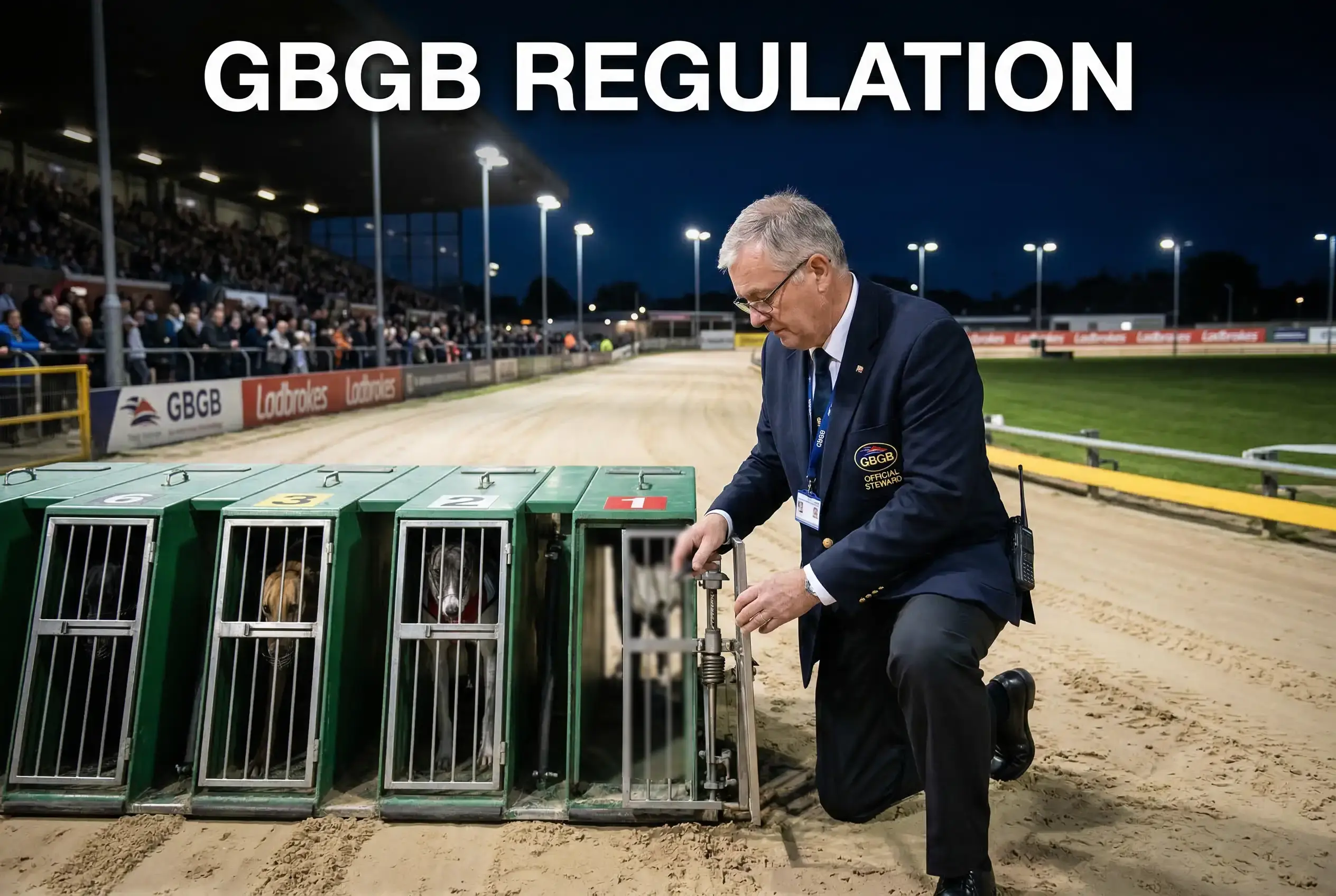
The GBGB: Who They Are and Why Every Licensed Track Answers to Them
The Greyhound Board of Great Britain is the governing and regulatory body for licensed greyhound racing in the UK. It oversees eighteen stadia, sets the rules under which racing takes place, licenses trainers and officials, manages the sport’s welfare programme and publishes the data that allows the public — and the sport’s critics — to assess how greyhound racing is run. Every dog that races at a licensed track, including Newcastle, is registered with the GBGB. Every result is recorded in its database. Every trainer holds a licence issued under its authority.
The GBGB greyhound board explained in simple terms is this: it is the body that stands between licensed greyhound racing and the unregulated alternative. Without the GBGB’s oversight, there would be no standardised rules, no mandatory veterinary cover, no injury reporting and no welfare accountability. The board’s existence is the sport’s primary argument that it operates responsibly — and its data is the primary evidence cited by both sides of the welfare debate. For anyone following racing at Newcastle or any other GBGB track, the board is the regulatory backbone that makes the sport function as a governed activity rather than an informal one.
See also: newcastle greyhound results — Newcastle greyhound racing insights.
Governance Structure and Key Responsibilities
The GBGB is governed by a board of directors that includes representatives from the sport’s key stakeholders: track operators, trainers, bookmakers and independent members with welfare or governance expertise. The board sets strategic direction, approves regulatory changes and oversees the executive team that runs the organisation’s day-to-day operations. The Chief Executive — currently Mark Bird — is responsible for implementing the board’s decisions and representing the sport publicly.
The GBGB’s responsibilities fall into four main areas. First, regulation: setting and enforcing the rules of racing, including race conditions, grading standards, anti-doping protocols and the licensing of trainers, officials and tracks. Second, welfare: managing the sport’s welfare strategy, publishing injury and retirement data, overseeing the kennel inspection programme and coordinating rehoming efforts across the licensed sector. Third, integrity: ensuring that racing is conducted fairly, through stipendiary stewards, on-track officials and a disciplinary process that can sanction trainers, owners or officials who breach the rules. Fourth, promotion: supporting the sport’s commercial interests through media partnerships, the centenary programme and engagement with government and regulatory bodies including the Gambling Commission.
Since the launch of the welfare strategy titled “A Good Life for Every Greyhound” in 2022, the GBGB has increased the frequency of routine kennel visits by 73.2%, according to its October 2025 progress report. These visits are conducted by welfare officers who assess the living conditions of racing greyhounds, check that trainers are meeting their regulatory obligations and identify any issues before they escalate. The increase in visit frequency is one of the most tangible measures of how the GBGB has intensified its oversight in response to public and political pressure.
How GBGB Enforces Rules: Stewards, Testing and Sanctions
Every licensed meeting is supervised by a stipendiary steward — a paid official appointed by the GBGB to ensure that the rules of racing are followed. The steward has the authority to call inquiries, review race footage, interview trainers and make decisions on disputed results. If a dog is found to have been interfered with, or if a trainer is suspected of a rule breach, the steward can refer the matter to the GBGB’s disciplinary panel.
Anti-doping is a core component of the enforcement regime. Dogs are tested at random after races, and the testing programme covers a range of prohibited substances — stimulants, sedatives, painkillers and other drugs that could affect performance or mask injury. Samples are analysed at an accredited laboratory, and the results are treated as confidential until a finding is confirmed. A positive test results in automatic suspension of the dog, an investigation into the trainer’s practices and, if a breach is confirmed, sanctions that can include fines, licence suspension or permanent exclusion from the sport.
The disciplinary process operates through a formal panel that hears evidence, considers representations from the accused and issues findings. Sanctions vary depending on the severity of the breach: minor infringements may result in a warning or a small fine, while serious offences — doping, cruelty, fraud — can lead to lengthy bans and criminal referral. The GBGB publishes the outcomes of disciplinary hearings, which provides a degree of transparency that the sport did not offer a decade ago.
Track-level enforcement also includes the racing manager, who is responsible for the day-to-day running of meetings at each venue. At Newcastle, the racing manager oversees grading decisions, going reports, trial runs and the mechanics of each card. The racing manager works within the GBGB’s framework but has discretion over operational details — which dogs are entered in which races, how the going allowance is set, whether a meeting should be abandoned due to weather. This layer of local authority, operating under national regulation, is how the GBGB’s rules translate into practice at the track level.
How GBGB Oversight Works at Newcastle Specifically
At Newcastle, GBGB oversight is visible on every race night. A stipendiary steward is present at every meeting, the racing manager coordinates the card within GBGB guidelines, and the track’s welfare officer liaises with the board on injury reporting, kennel visits and rehoming coordination. The results from every race are uploaded to the GBGB’s central database, where they become part of the permanent record used for grading, form analysis and welfare monitoring.
Learn about greyhound registration.
Newcastle’s status as an ARC-operated venue means that its compliance with GBGB standards is also subject to the operator’s own internal governance. ARC has corporate policies on welfare, safety and operational standards that sit alongside the GBGB’s regulatory requirements. In practice, this means two layers of accountability: the GBGB as the national regulator and ARC as the corporate owner, both with an interest in ensuring that Brough Park meets the expectations placed on a licensed greyhound stadium hosting Category 1 events.
For the punter or the visitor, the GBGB’s presence at Newcastle may not be immediately visible. You do not see the kennel visits, the drug tests or the disciplinary hearings. What you see is a race meeting that runs to schedule, with results published promptly, injuries reported transparently and a welfare framework that — whatever its limitations — exists and operates. The GBGB greyhound board explained in terms of its practical impact on Newcastle is this: it is the reason the racing you watch at Brough Park is licensed, regulated and accountable, rather than a free-for-all where anything goes.
