 Available in US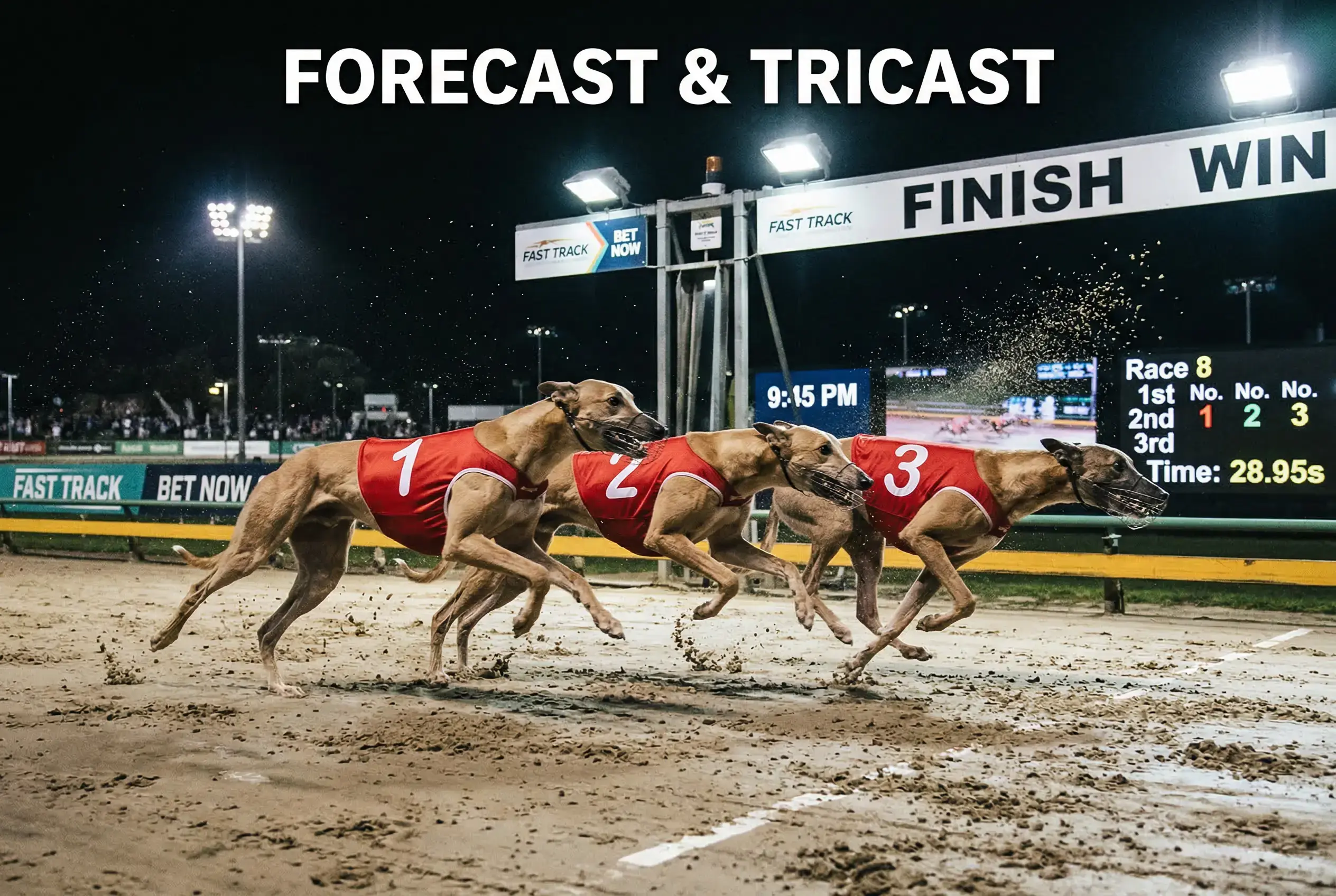
Forecast and Tricast Bets: How They Work at Newcastle
Win betting is the simplest form of greyhound wager: pick the dog that crosses the line first, collect if you are right. Forecast and tricast bets raise the stakes. A forecast requires you to predict the first two finishers in the correct order. A tricast demands the first three. The difficulty is higher, but so are the potential returns — and at Newcastle, where graded races regularly produce competitive fields of six evenly matched dogs, forecast and tricast dividends can be substantial.
Newcastle greyhound forecast and tricast betting follows the same rules as every other GBGB-licensed track, but the dividends are shaped by the specific characteristics of each race. A wide-open handicap at 480 metres, where the form suggests three or four dogs have a realistic chance, will typically produce larger dividends than a race dominated by an obvious favourite. Understanding the mechanics of how these bets work — and how to read the dividends once they are published — is essential for anyone looking beyond straightforward win punting.
The structure is not complicated. The terminology can be off-putting at first glance, with terms like CSF, combination forecast and reverse forecast cluttering the racecard. But strip away the jargon and the underlying logic is straightforward: you are predicting the order of finish, and the payout reflects how unlikely that order was.
See also: newcastle greyhound results — your Newcastle greyhound racing reference.
Straight, Reverse and Combination Forecasts
A straight forecast is the purest version of the bet. You select two dogs and predict that Dog A will finish first and Dog B will finish second, in that exact order. If Dog A wins and Dog B comes second, you collect. If they finish the other way around — Dog B first, Dog A second — you lose. The straight forecast rewards precision, and the dividend reflects the improbability of that precise outcome.
A reverse forecast covers both permutations. You still select two dogs, but your bet wins if either one finishes first and the other finishes second, regardless of order. In practice, a reverse forecast is two straight forecast bets combined, so your stake is doubled. If your two selections fill the first two places in either order, you are paid the CSF dividend for the actual finishing order. The reverse forecast is a sensible option when you are confident two dogs will dominate a race but less certain which one will lead the other home.
A combination forecast extends the principle further. You select three or more dogs, and the bet covers every possible forecast permutation among your selections. With three dogs, that means six separate straight forecast bets (each pair in both orders). With four dogs, it becomes twelve. The cost multiplies quickly, but the logic is sound in races where you believe the first two will come from a group of three or four contenders and you want to cover all outcomes. Greyhound racing, with its six-runner fields and frequent competitive clashes, lends itself well to combination forecasts — more so than horse racing, where field sizes can make the maths prohibitive.
The total prize money pool in UK greyhound racing stands at over £15.7 million across all licensed tracks. That figure reflects the scale of the sport and the volume of competitive racing available. Within that ecosystem, Newcastle’s regular four-day-a-week schedule provides ample opportunity to apply forecast betting systematically rather than sporadically. The key is selectivity: not every race is suited to a forecast bet, and forcing one into a race where the form points to a single dominant runner is a waste of stake money.
Tricast Betting: Picking the First Three Home
A tricast works on the same principle as a forecast but adds a third selection. You predict the first, second and third finishers in the exact order. In a six-runner greyhound race, there are 120 possible tricast permutations, which gives you a sense of why tricast dividends are typically much larger than forecast dividends — the probability of nailing the exact order of the first three is low, and the payout compensates for that difficulty.
As with forecasts, you can bet a straight tricast (one specific order) or a combination tricast (covering multiple permutations). A combination tricast on three dogs covers all six possible orderings of those three runners, so your stake is multiplied by six. Selecting four dogs for a combination tricast covers twenty-four permutations. The arithmetic escalates fast, and the cost of a full combination tricast on four or more dogs can exceed the potential return if the dividend is modest. Working out the break-even point before placing the bet is not optional — it is the difference between a calculated risk and a blind punt.
Tricast betting is at its most productive in races where the form separates a group of three from the rest of the field but leaves the order within that group genuinely uncertain. At Newcastle, this scenario arises frequently in graded races at 480 metres, where the grading system is designed to produce competitive fields. If three dogs look a class above the other three but you cannot confidently rank them, a combination tricast on those three covers all six possible outcomes and gives you a realistic chance of landing a meaningful dividend.
The trap draw adds a layer that pure form analysis misses. Two dogs with identical form figures may have very different prospects depending on which trap they occupy. A dog drawn in a trap that historically favours front-runners will be harder to peg back from second or third, which reshapes the likely finishing order. Folding trap data into your tricast selection is what turns a coin-flip permutation into an informed one.
How Forecast and Tricast Dividends Appear in Newcastle Results
After every Newcastle race, the official result card includes two dividend figures alongside the finishing positions and starting prices: the computer straight forecast (CSF) and, where applicable, the tricast dividend. These numbers represent the return to a £1 unit stake. A CSF of £28.40 means that a £1 straight forecast on the correct first and second would return £28.40. A tricast dividend of £185.00 means a £1 straight tricast on the correct first three, in order, returns £185.00. Official results, including forecast and tricast dividends for every meeting, are published on the GBGB website.
Check the Newcastle greyhound odds.
The CSF is calculated using a mathematical model rather than by a pool of bets. It takes into account the starting prices of the first two finishers and produces a dividend that reflects the implied probability of that exact outcome. The model ensures consistency: the same two SPs will always generate the same CSF, regardless of whether the race took place at Newcastle, Hove or Romford. This makes CSF dividends comparable across tracks and meetings, which is useful if you are tracking forecast profitability over time.
Tricast dividends can be calculated in two ways depending on the operator. Some use a computer model similar to the CSF; others derive the tricast from a pool (the Tote tricast). The pool-based version can fluctuate more wildly because it depends on how much money was bet and how it was distributed across the permutations. On a quiet Tuesday afternoon BAGS meeting at Newcastle, a thin pool can produce either an inflated tricast dividend or, occasionally, one that looks disappointingly low relative to the difficulty of the bet. On busier Saturday evening cards, pools tend to be deeper and dividends more predictable.
The retail betting market on greyhound racing, which generated £794 million in turnover in the year to March 2024 according to Gambling Commission data, provides the financial engine behind these pools and models. That turnover flows through betting shops, online operators and on-course bookmakers, and the dividends published after each Newcastle race reflect the collective weight of all that activity. When a CSF comes in at £80 or a tricast exceeds £500, it means the result genuinely surprised the market — and your forecast or tricast bet happened to be on the right side of that surprise.
Reading dividends over time also reveals patterns about the track. If Newcastle’s 480-metre races consistently produce higher CSF dividends than its 290-metre sprints, that tells you the longer distance produces more competitive, less predictable outcomes. That information feeds back into your selection process: it suggests that forecast and tricast bets may offer better value at 480 metres than at shorter distances where one or two dogs tend to dominate.
