
 Available in US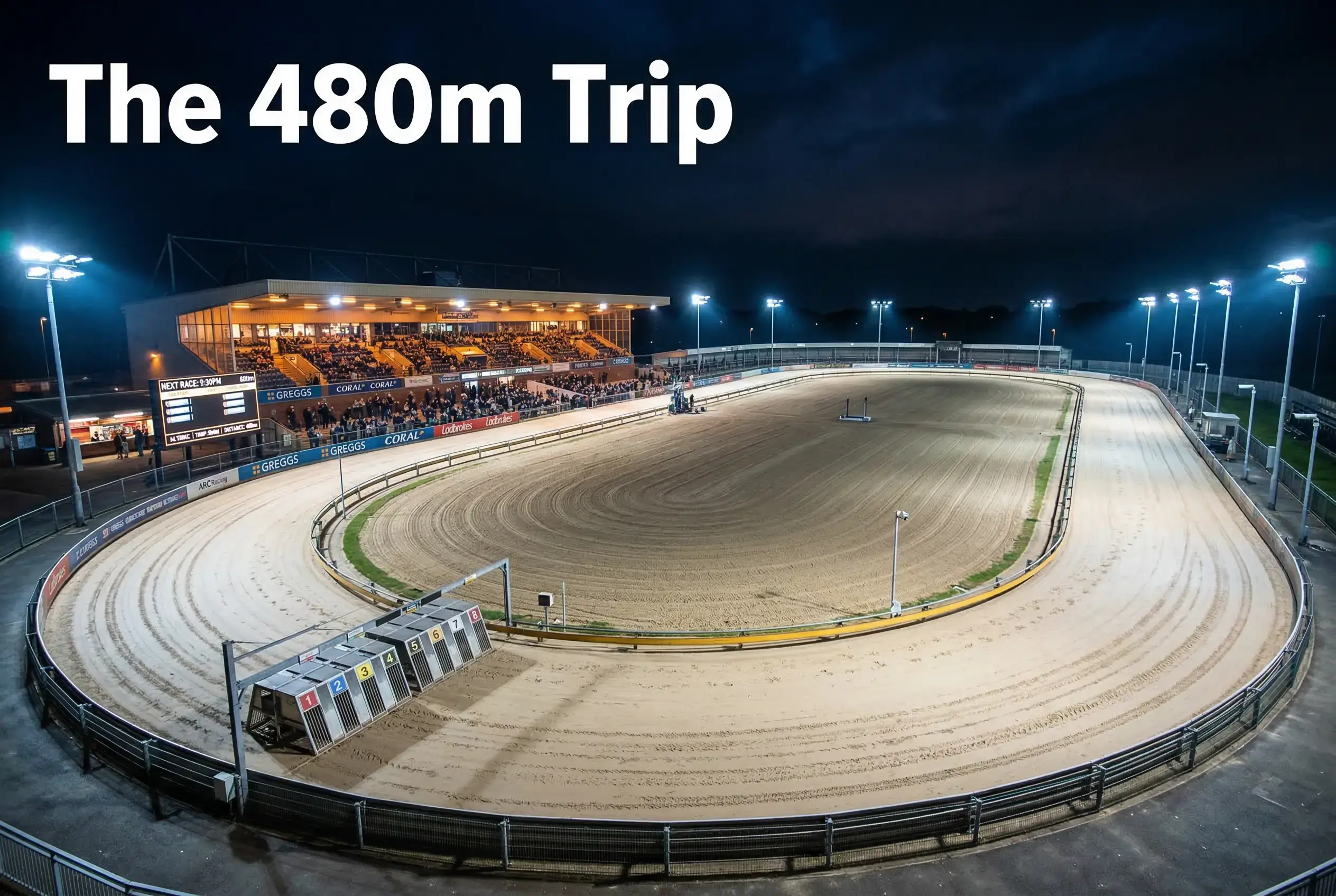
Why 480 Metres Is the Heart of Newcastle’s Racing Programme
Every greyhound track has a bread-and-butter distance — the trip that fills the majority of races on every card. At Newcastle, that distance is 480 metres. It is the standard four-bend trip on the 415-metre circumference at Brough Park, and it accounts for the largest share of races across Tuesday, Wednesday, Thursday and Saturday meetings. Graded races, open races and trial stakes are all routinely run at 480 metres, which makes it the distance with the deepest pool of form data and the most reliable benchmarks for comparison.
Newcastle greyhound 480m results tell you more about the track’s competitive landscape than any other distance. The sprints at 290 metres are over quickly and leave less room for tactical variation. The middle-distance and marathon races at 680 metres and beyond are run less frequently and attract smaller fields. At 480 metres, the sample is large, the fields are competitive and the form is dense enough to support genuine analysis. If you are going to specialise in one distance at Brough Park, this is the one.
See also: newcastle greyhound results — all Newcastle greyhound results and tips.
The 480m Course: Start Position, Bends and Finishing Line
The 480-metre start at Newcastle is positioned on the back straight, giving runners a run-up to the first bend that is longer than the sprint distances but shorter than the marathon starts. This run-up is where the race begins to take shape. Dogs that break cleanly from the traps and reach the first bend in front gain an immediate advantage, because once the field compresses on the turn, recovering lost ground without being forced wide becomes much harder.
From the first bend, the race flows through four turns in total — a pair on each end of the oval — with two straights connecting them. The bends at Brough Park are relatively tight for a 415-metre track, which penalises dogs that drift wide and rewards those that hold a close racing line. The camber of the bends and the consistency of the sand surface both influence how much grip a dog has through the turns, and these factors can vary with maintenance cycles and weather.
The finishing straight runs from the final bend to the winning post. At 480 metres, the finish is positioned after the fourth bend, which means dogs entering the straight are either maintaining a lead they established early or attempting to close a gap they have been carrying through the back section. The length of the finishing straight determines how much room a closer has to run down the leaders. At Newcastle, the straight is long enough that genuine closers can make up two or three lengths if they have the pace — but not long enough to rescue a dog that was five lengths adrift at the last bend.
The physical layout of the 480-metre course at Brough Park shapes every aspect of the form produced at this distance. The run-up favours clean breakers, the bends reward railers and the finishing straight gives closers a chance. Understanding how these segments interact is the first step toward reading Newcastle greyhound 480m results with any depth.
Trap Bias Data Specific to Newcastle 480m Races
Trap bias is not uniform across distances. The same track can show a pronounced inside-trap advantage at one distance and a more balanced distribution at another, depending on where the start position sits relative to the first bend and how the bends interact with each trap’s racing line. At Newcastle, the 480-metre distance has its own specific bias profile, and treating it as identical to the 290-metre or 680-metre data is a mistake.
GreyhoundStats.co.uk publishes current-year trap win percentages for Newcastle broken down by distance, covering both graded and open races. The data is updated as results come in, which means the figures you see today reflect the most recent form rather than a historical average that may no longer be accurate. For the 480-metre distance, the win rates for each of the six traps provide a clear picture of which starting positions carry a statistical edge.
In general terms, inside traps at 480 metres tend to enjoy an advantage at tracks with tight bends, because the shorter distance to the rail on the first turn translates into a positional gain that compounds through subsequent bends. At Newcastle, the 415-metre circumference creates bends that are sharp enough for this effect to be significant. Trap one and trap two typically outperform the theoretical even-chance figure of 16.66%, while the wider traps — particularly trap five and trap six — tend to underperform.
The size of that bias fluctuates from season to season. Track maintenance, changes to the sand surface and even shifts in the greyhound population (more or fewer natural railers in the graded pool) can alter the numbers. Checking the current data before each card, rather than relying on a figure from six months ago, is the only way to ensure you are working with an accurate bias picture. A trap that was neutral in January may have become favourable by June, or vice versa, and the GreyhoundStats database captures that drift in real time.
Common Form Patterns Seen Over 480 Metres at Brough Park
Certain form patterns recur at 480 metres with enough regularity to be useful. The most common is the front-runner that controls the race from the first bend. At Newcastle, where the rail is valuable and positional advantage compounds through each turn, dogs that lead through the first two bends win a disproportionate share of 480-metre races. If a dog’s recent form shows it leading at the first bend in three of its last four runs, and it is drawn in a trap that historically produces front-runners, the pattern points in one direction.
Explore Newcastle greyhound track records.
The second pattern is the closer that is consistently finishing fast but failing to get up in time. These dogs are identifiable through their sectional data: they record the fastest or second-fastest run-in split but finish second or third because they conceded too much ground on the bends. When such a dog draws a better trap or faces a field with less early pace, the finishing speed it has been demonstrating becomes a winning weapon rather than a consolation prize. Identifying these near-misses before the market catches on is one of the most reliable ways to find value at 480 metres.
A third pattern involves dogs moving between distances. A dog that has been racing at 680 metres and drops back to 480 may carry more natural speed over the shorter trip, because its stamina is more than adequate and its pace, relative to 480-metre specialists, is sharper than its longer-distance form suggests. Conversely, a dog stepping up from 290-metre sprints to 480 metres may struggle to sustain its speed through four bends after being accustomed to two. Distance switches are transition points in a dog’s form, and they create pockets of uncertainty that the market does not always price efficiently.
Finally, the grading system itself produces a pattern. Dogs that have been winning at a lower grade and are promoted into a higher graded 480 face stiffer competition, and their form figures may temporarily dip. The opposite is true for dogs that have been struggling at a higher grade and drop down. Grading moves are published in advance on the racecard, and factoring them into your reading of Newcastle greyhound 480m results is the difference between seeing a dog’s recent form at face value and understanding the context that shaped it.
