 Available in US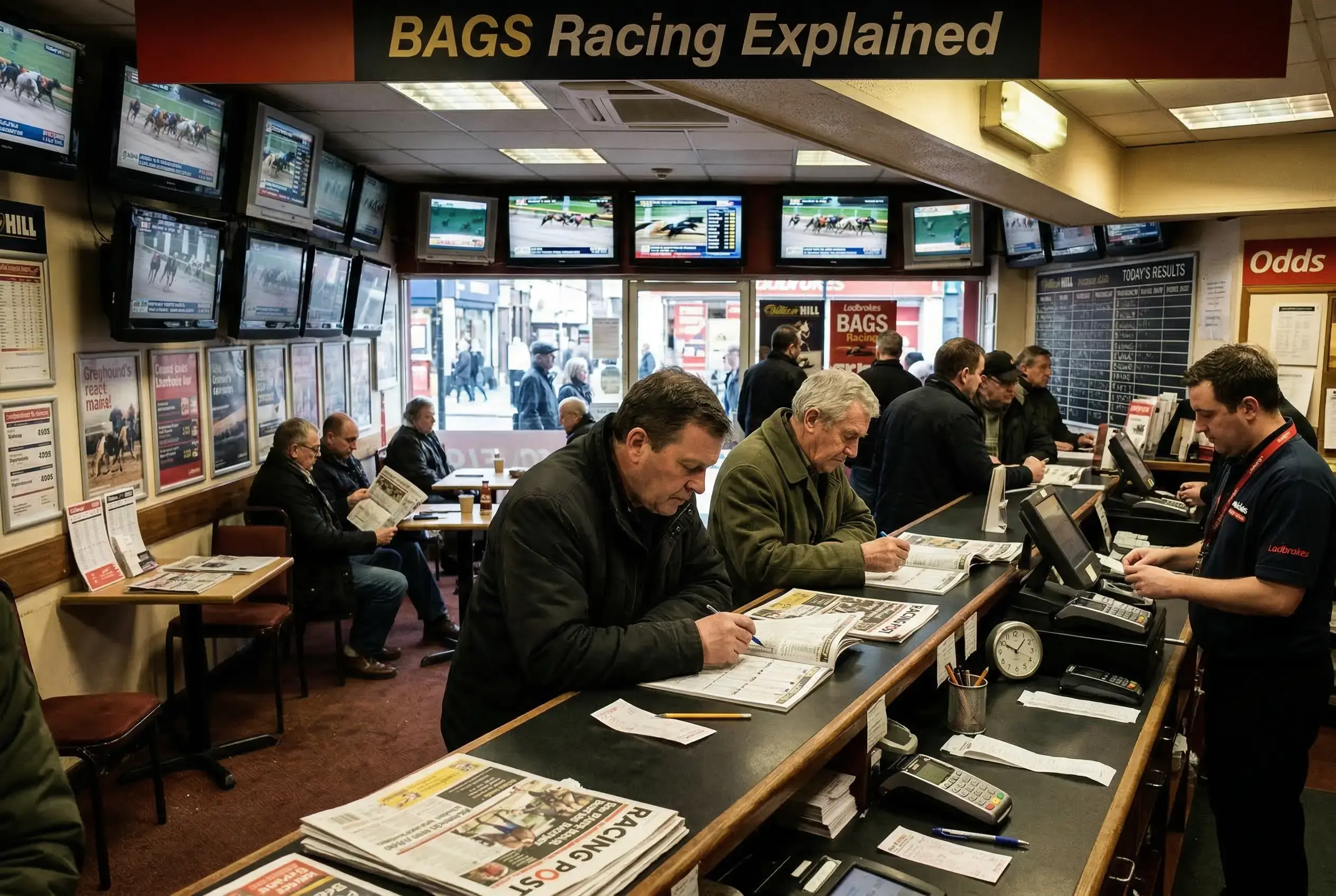
BAGS Meetings: The Engine Behind Daytime Greyhound Racing
If you have ever walked into a bookmaker’s shop on a weekday afternoon and seen greyhound racing on the screens, you have watched a BAGS meeting. BAGS — the Bookmakers Afternoon Greyhound Service — is the system that provides daytime greyhound racing content to betting shops across the UK. It is not a single organisation but a framework: a coordinated schedule of meetings at licensed tracks, timed and structured to give bookmakers a continuous stream of racing content from late morning through to the early evening.
BAGS meetings in greyhound racing are the commercial backbone of the sport. They generate the betting turnover that funds track operations, contributes to prize money and keeps the weekly schedule running at venues like Newcastle. Without BAGS, the number of race meetings at most UK tracks would drop dramatically, and the financial model that supports licensed greyhound racing would look very different. Understanding what BAGS is, how it works and what it means for the racing you see at Brough Park is essential context for anyone who follows greyhound results with any regularity.
See also: newcastle greyhound results — your source for Newcastle greyhound info.
How BAGS Provides Content to Betting Shops Nationwide
The mechanics of BAGS are straightforward. A group of licensed tracks is allocated slots in a daily schedule, and each track runs a meeting during its assigned window. The races are broadcast live into betting shops via SIS — Satellite Information Services — which handles the distribution of audio, video and data feeds. The punter in a Coral shop in Birmingham can watch and bet on a BAGS race at Newcastle at the same time as a customer in a Ladbrokes in Bristol, because both shops are receiving the same SIS feed.
The financial flow works in the opposite direction. Betting turnover generated by BAGS meetings flows from the bookmakers back to the tracks through a combination of media rights payments and the voluntary levy administered by the BGRF (British Greyhound Racing Fund). Retail betting turnover on greyhound racing reached £794 million in the year ending March 2024, according to Gambling Commission data. A substantial portion of that total comes from BAGS meetings, which are specifically designed to serve the betting shop audience during hours when horse racing may not be available.
The Entain–ARC media rights joint venture, which holds exclusive premium content rights for twelve stadia including Newcastle from 2024 to 2029, is the most significant deal in the current BAGS distribution landscape. The JV structures how Newcastle’s BAGS content is packaged, distributed and monetised, and it ensures that the track’s midweek meetings reach the widest possible audience of betting shop screens and online platforms.
The schedule itself is coordinated centrally. Tracks do not choose their own BAGS slots independently — the timing is managed to avoid overlaps and to provide a continuous flow of racing content throughout the day. A typical BAGS afternoon might feature meetings from three or four different tracks running sequentially, so that as one meeting’s final race ends, the next track’s card begins. The result is that a betting shop customer can watch greyhound racing for five or six hours without interruption, moving from one venue to the next as the schedule rolls forward.
Newcastle’s Role in the BAGS Calendar
Newcastle contributes to the BAGS schedule on its midweek race days — Tuesdays, Wednesdays and Thursdays. These afternoon meetings are the workhorses of the Brough Park programme. They are graded races, meaning dogs are placed in classes according to their recent form and times, and the fields are designed to be competitive rather than mismatched. The aim is to produce close, unpredictable racing that encourages betting activity — which is, after all, the commercial purpose BAGS exists to serve.
The typical Newcastle BAGS card carries around twelve races, spaced at approximately fifteen-minute intervals, with the first race usually starting between 11am and 1pm depending on the day’s schedule. The majority of races are run at 480 metres over four bends, though shorter sprints and longer distances may also feature. The going is reported before the first race, and calc times are published alongside raw finishing times so that form can be compared across meetings run on different going.
From a form perspective, BAGS meetings at Newcastle produce the bulk of the track’s weekly data. If you are building a form picture for a dog that races regularly at Brough Park, the midweek BAGS cards are where most of its recent runs will have taken place. Saturday evening open races may be the glamour fixtures, but the BAGS programme is where the volume sits — and volume is what gives form analysis its reliability.
The grading at Newcastle BAGS meetings is managed by the racing manager, who adjusts grades based on recent results and times. A dog that wins convincingly in a lower grade will be promoted; one that consistently finishes at the back will drop. This system keeps the racing competitive, which is good for both the betting market and the spectacle, but it also means that a dog’s grade can change from one midweek meeting to the next. Checking the grade before assessing form is a basic step that casual punters sometimes overlook.
What BAGS Means for Punters Betting on Newcastle Races
For the punter, BAGS meetings have a specific character. The markets are priced early — often hours before the first race — because the betting shop audience needs odds on the screens before customers walk in. That early pricing creates opportunities for value, because the market at 10am may not have absorbed information that emerges later in the morning. A late withdrawal, a change in trap draw or a shift in going can all alter the complexion of a race, and the punter who checks these details closer to race time may find prices that do not reflect the updated information.
Learn about Arena Racing Company.
The flip side is that BAGS markets can be thinner than evening markets. The volume of money wagered on a Tuesday afternoon BAGS race at Newcastle is typically lower than on a Saturday evening open event, which means individual bets have more impact on the price. A single significant wager can shift the odds noticeably, and the starting price may differ from the early price by a wider margin than you would see on a busier card.
BAGS meetings also tend to produce more consistent form data than event nights, precisely because the fields are graded and the competition is structured. A dog that runs well in a midweek A3 graded race at Newcastle is demonstrating a reliable level of ability, and that level can be used as a reference point when the same dog appears on a future card. The grading system, combined with the sheer frequency of BAGS meetings, gives punters a deeper well of data to draw from than occasional open events can provide.
Whether you follow BAGS meetings in greyhound racing through a betting shop screen, a streaming app or a results page, the principle is the same: these are real races, producing real form, with real money at stake. The setting may be less atmospheric than a Saturday night under the lights at Brough Park, but the data is just as valid — and for the analytical punter, it is often more useful.
