
 Available in US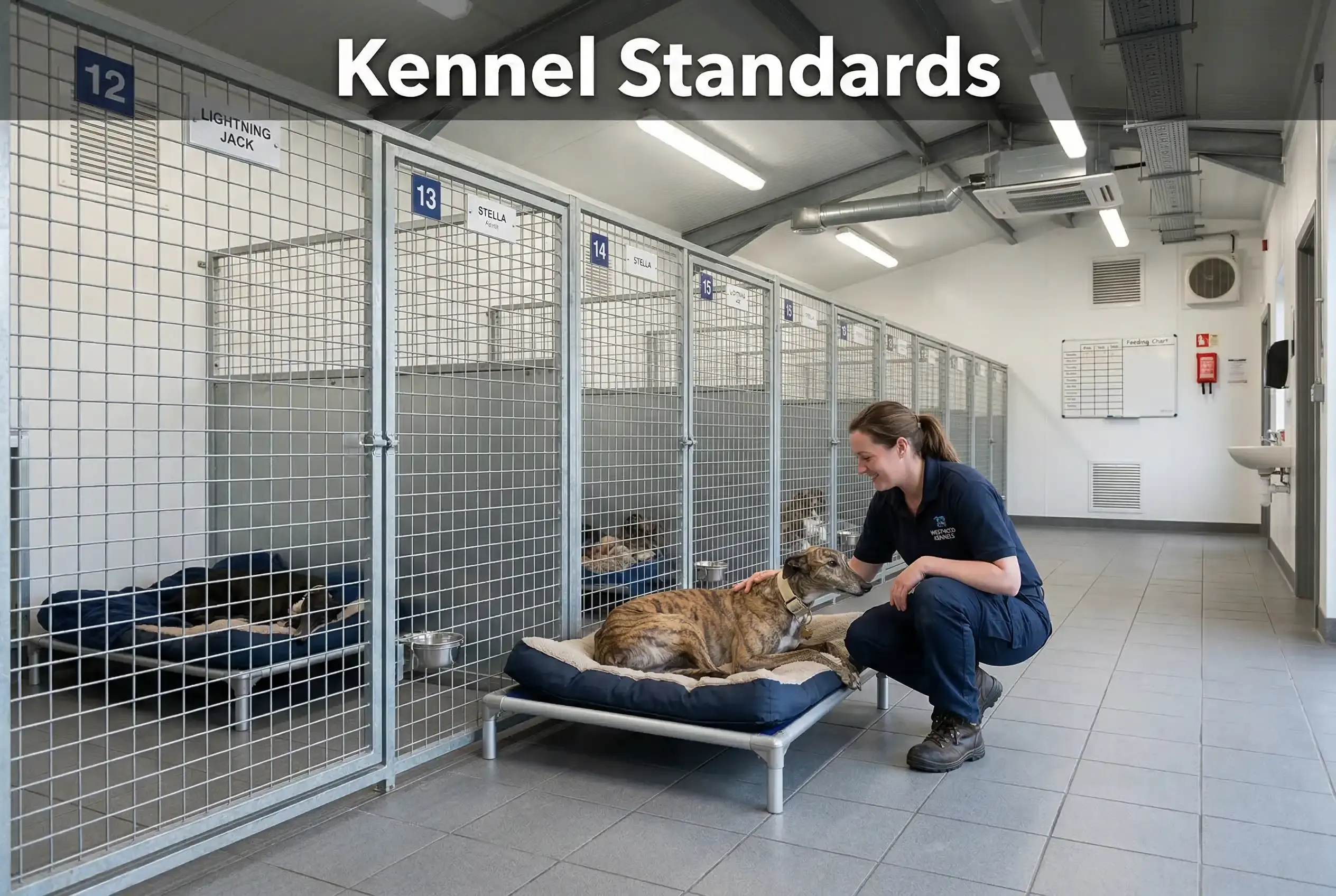
Inside the Strategy to Improve Greyhound Kennel Standards
The condition in which a racing greyhound lives is as important to its welfare as the condition in which it races. Kennels are where dogs spend the vast majority of their time — eating, sleeping, recovering between races — and the standard of those facilities directly affects the animal’s physical health and psychological wellbeing. In 2022, the GBGB launched its welfare strategy under the title “A Good Life for Every Greyhound,” and one of its most measurable outcomes has been a 73.2% increase in routine kennel visits since the programme began.
Greyhound kennel standards GBGB sets are the regulatory floor that every licensed trainer must meet. But the strategy goes beyond minimum compliance. Through increased inspections, funded kennel upgrades and a comprehensive programme of continuing professional development for trainers, the GBGB is attempting to shift the culture of the sport from one that treated kennel conditions as a private matter to one that treats them as a shared responsibility. The data so far suggests progress, though the scale of the challenge — approximately 500 licensed trainers spread across the country — means that change is gradual rather than overnight.
See also: newcastle greyhound results — your Newcastle greyhound resource.
Kennel Visit Programme: Frequency, Scope and Findings
The kennel visit programme is the most visible component of the GBGB’s welfare strategy. Welfare officers employed by the board conduct routine visits to trainers’ kennels, assessing the condition of the facilities, the health and wellbeing of the dogs, and the trainer’s compliance with GBGB standards. The visits are not announced in advance — they are unannounced inspections designed to capture a genuine picture of how dogs are housed and cared for on a typical day, not a version polished for the inspector’s benefit.
Since the strategy launched in 2022, the frequency of these visits has increased by 73.2%, according to the GBGB’s October 2025 progress report. The increase reflects both a growth in the welfare officer workforce and a deliberate policy decision to make inspections a routine part of the sport’s operations rather than a response to specific complaints. The aim is proactive oversight: identifying and addressing issues before they become serious, rather than waiting for a problem to surface publicly.
The scope of each visit covers multiple areas: the physical condition of the kennel (bedding, ventilation, temperature, cleanliness), the health of the dogs (body condition, dental health, coat quality, signs of injury or neglect), the trainer’s record-keeping (vaccination records, worming schedules, retirement plans) and the general management of the facility. Where issues are identified, the welfare officer can require improvements within a specified timeframe, and follow-up visits confirm compliance. Persistent or serious breaches are referred to the GBGB’s disciplinary process.
The Trainers’ Assistance Fund, which distributed £503,910 in 2024, is directly linked to the inspection programme. Where a kennel visit identifies that a trainer’s facilities need upgrading — new flooring, improved drainage, better heating — the fund provides financial support to make the improvements. The logic is practical: setting a standard without helping trainers meet it would be punitive rather than productive, and the fund bridges the gap between regulation and reality for trainers who operate on tight margins.
Trainer Education: 582 Hours of Free CPD in 2024
The second pillar of the strategy is education. In 2024, the GBGB delivered 582 hours of free continuing professional development for trainers and industry stakeholders. The CPD programme covers topics ranging from greyhound nutrition and injury prevention to kennel management, retirement planning and mental health support for trainers themselves. The content is developed in partnership with academic institutions including the University of Surrey, the University of Nottingham and University College Dublin, which gives it a credibility that in-house training alone would not carry.
The outgoing Chairman of the GBGB has described the current era as one in which racing greyhounds receive the highest level of care and protection in the sport’s history — a claim that the CPD programme is designed to substantiate. The argument is that welfare cannot be achieved through regulation alone; it requires a workforce that understands best practice and is equipped to implement it. The 582 hours of free CPD represent an investment in that workforce, and the participation rates suggest that trainers are engaging with the programme rather than treating it as a box-ticking exercise.
Topics vary by session but frequently address areas where the GBGB’s data has identified room for improvement. If injury data shows a spike in a particular type of injury at certain tracks, CPD sessions may focus on the training practices or kennel conditions that contribute to that injury type. If rehoming data reveals that dogs from certain kennels take longer to adapt to domestic life, sessions may address socialisation techniques that better prepare dogs for retirement. The programme is responsive rather than static, and it evolves as the data reveals where the biggest gains can be made.
Trainers’ Assistance Fund: £503k for Kennel Upgrades
The Trainers’ Assistance Fund is the financial mechanism that connects the GBGB’s welfare ambitions to physical improvements in kennel conditions. In 2024, the fund distributed £503,910 to licensed trainers across the country, supporting projects that range from new kennel flooring and improved drainage systems to insulation, heating upgrades and the installation of exercise facilities.
Read about greyhound welfare in the UK.
The fund is not a handout. Applications are assessed against the welfare improvements they will deliver, and the GBGB monitors whether the work is completed to the required standard. Trainers who receive funding are subject to follow-up visits to verify that the investment has been used appropriately and that the resulting facilities meet the board’s expectations. The process is designed to ensure accountability — public and industry money is being spent, and the GBGB has a responsibility to demonstrate that it is spent effectively.
For trainers at Newcastle and other tracks, the fund addresses a real barrier. Many trainers operate small businesses with limited capital reserves, and the cost of a significant kennel upgrade — several thousand pounds for flooring, drainage or heating — can be prohibitive without external support. The fund lowers that barrier, making it possible for trainers to improve their facilities to a standard that the GBGB’s welfare strategy demands. The alternative — setting standards that trainers cannot afford to meet — would push some out of the sport entirely, which would reduce the active trainer pool and potentially harm the welfare of the dogs that those trainers would have continued to care for.
The £503,910 distributed in 2024 is a meaningful sum, but it covers hundreds of kennels across eighteen tracks. The per-trainer allocation is modest, and the fund cannot address every need in a single year. What it can do is establish a pattern of ongoing investment that accumulates over time — each year bringing a proportion of kennels closer to the standard the GBGB has set. Greyhound kennel standards GBGB enforces are not aspirational targets; they are minimum requirements backed by inspection, funding and, where necessary, enforcement. The combination of all three is what gives the strategy its credibility.
