 Available in US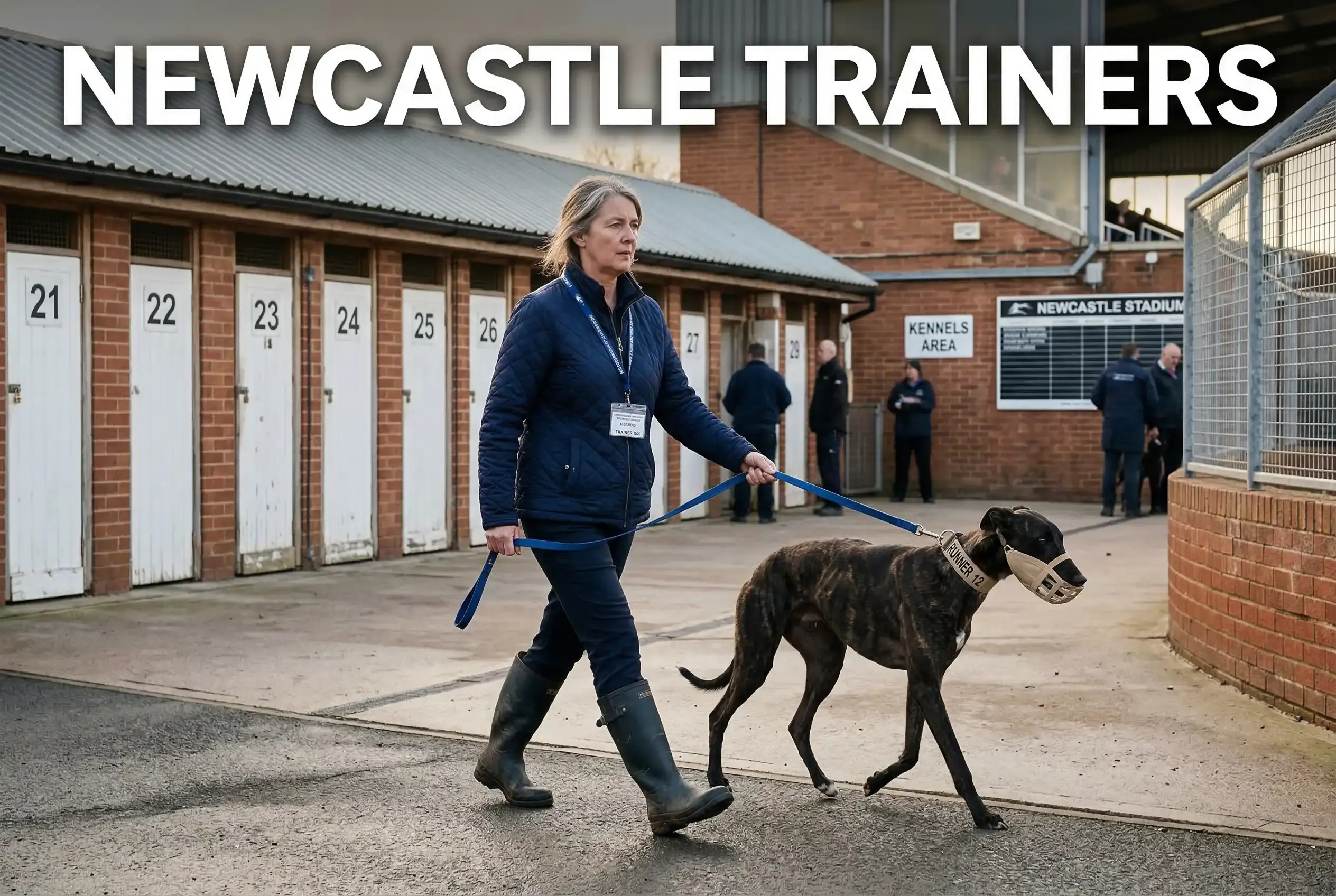
The People Behind the Results: Trainers at Newcastle
Every result at Newcastle begins in a kennel. Before a greyhound reaches the traps at Brough Park, it has been fed, exercised, trialled, assessed and placed in a race by a trainer who knows its strengths, its weaknesses and its current level of fitness. The trainer is the single most important human influence on a racing greyhound’s career, and at Newcastle — where a relatively small group of trainers dominates the graded programme — understanding who trains the dog is as relevant to form study as knowing which trap it is drawn in.
Across the UK, the GBGB-licensed sector includes approximately 500 trainers responsible for the daily care and competitive management of racing greyhounds. These trainers work with around 15,000 registered owners and are supported by some 3,000 kennel staff. It is a compact professional community, and at the Newcastle level it is even smaller — a handful of trainers account for a significant proportion of the runners on any given card. Knowing the greyhound trainers at Newcastle, their methods and their form is part of reading the racecard with any depth.
See also: newcastle greyhound results — complete Newcastle greyhound analysis.
What a Greyhound Trainer Does: From Kennel to Trap
A greyhound trainer’s day starts early and runs long. The morning routine involves feeding, cleaning kennels and assessing each dog’s condition — checking for signs of injury, illness or fatigue. Dogs in active training are exercised on a schedule tailored to their racing programme: sprint dogs may do short, high-intensity gallops, while middle-distance dogs need longer sessions to build stamina. The exercise regime is adjusted for race days, rest days and the days immediately after a race, when recovery takes priority.
Trial runs at the track are a regular part of the training cycle. Trainers use trials to assess a dog’s current fitness, to introduce a new dog to the track, or to test a dog’s performance at a different distance. At Newcastle, trial sessions are available on non-race days and give trainers the opportunity to see how their dogs handle the bends, the sand surface and the hare system at Brough Park. The data from these trials feeds directly into the trainer’s decisions about which races to enter and which traps to request.
On race day, the trainer’s role shifts to logistics and strategy. Dogs are transported to the track, weighed in, inspected by the veterinary team and placed in the parade ring before each race. The trainer has already decided the race entry, but last-minute adjustments — withdrawals due to injury, changes in going conditions, tactical considerations based on the opposition — can alter the plan. Once the traps open, the trainer becomes a spectator like everyone else. The preparation is complete, the months of work compressed into thirty seconds of racing. The execution belongs to the dog.
Beyond the daily routine, trainers manage the longer-term development of each dog’s career: deciding when a dog is ready to step up in grade, when to rest an animal that has been racing frequently, and when a dog’s racing days are over and the transition to rehoming should begin. The best trainers balance competitive ambition with welfare responsibility, and the GBGB’s regulatory framework reinforces that balance through kennel inspections, welfare visits and licensing requirements.
How Trainers Get Licensed and What GBGB Requires
To train greyhounds at a GBGB-licensed track, a trainer must hold a licence issued by the board. The licensing process involves an application, a kennel inspection and an assessment of the applicant’s knowledge and experience. New trainers typically enter the profession through an attachment — a period of supervised training under an established licence holder — that allows them to learn the regulatory requirements, welfare obligations and practical skills of the role before taking on a kennel of their own.
Once licensed, trainers are subject to ongoing oversight. Kennel inspections, drug testing of their dogs, adherence to grading rules and compliance with welfare standards are all conditions of holding a licence. A licence can be suspended or revoked if a trainer is found to have breached the rules, and the GBGB’s disciplinary process provides the mechanism for enforcement. The regulatory burden is real, but trainers within the licensed sector generally accept it as the price of operating within a framework that gives their results legitimacy and their dogs access to regulated competition.
The financial reality of training greyhounds is challenging. Prize money at the graded level is modest, and the cost of maintaining a kennel — feed, veterinary care, staff, transport, bedding — is substantial. In 2024, the GBGB distributed £503,910 through the Trainers’ Assistance Fund, which supports kennel upgrades and infrastructure improvements for licensed trainers. The fund, detailed in the GBGB’s October 2025 progress report, is an acknowledgement that many trainers operate on thin margins and that the quality of the kennel environment is directly linked to the welfare of the dogs in their care.
The Newcastle Trainers Championship: Format and Past Winners
The Trainers Championship at Newcastle, established in 1977, is a season-long competition that rewards consistency rather than a single outstanding performance. The championship tracks the results of each trainer’s dogs across a defined period, and the trainer with the best overall record — measured by wins, placings and points accumulated — is declared the champion at the end of the season.
Check our Newcastle greyhound tips.
The format encourages trainers to perform across the full range of distances and grades at Brough Park, not just in the headline events. A trainer who dominates the graded 480-metre programme but neglects sprints or middle-distance races will lose ground to a rival with a broader strike rate. The championship is a test of depth — how many good dogs a kennel has and how well they are placed across the track’s racing menu.
Jimmy Fenwick, whose dog Wicky Ned won the Greyhound of the Year award in 2024, exemplifies the kind of trainer who thrives in the championship format. Fenwick’s kennel competes across distances and grades, and his stated ambition to build a team capable of challenging at national level — including competing with the Irish-bred dogs that dominate the sport’s top events — reflects a confidence grounded in sustained local success. As Fenwick put it after the GBGB Awards, he believes the Newcastle operation now has the quality to compete at the highest level, a perspective that comes from years of building a competitive kennel from a North East base.
The Trainers Championship adds a narrative thread to the Newcastle season that exists independently of individual races. It gives regular racegoers something to follow beyond the result of the next race — a storyline that unfolds over months and rewards attention. For casual visitors, the championship may go unnoticed. For the regulars who attend week after week, it is the running subplot of the season. For the greyhound trainers at Newcastle, it is the local title that matters most: the recognition, from peers and punters alike, that their kennel was the best at Brough Park over a full campaign.
