
 Available in US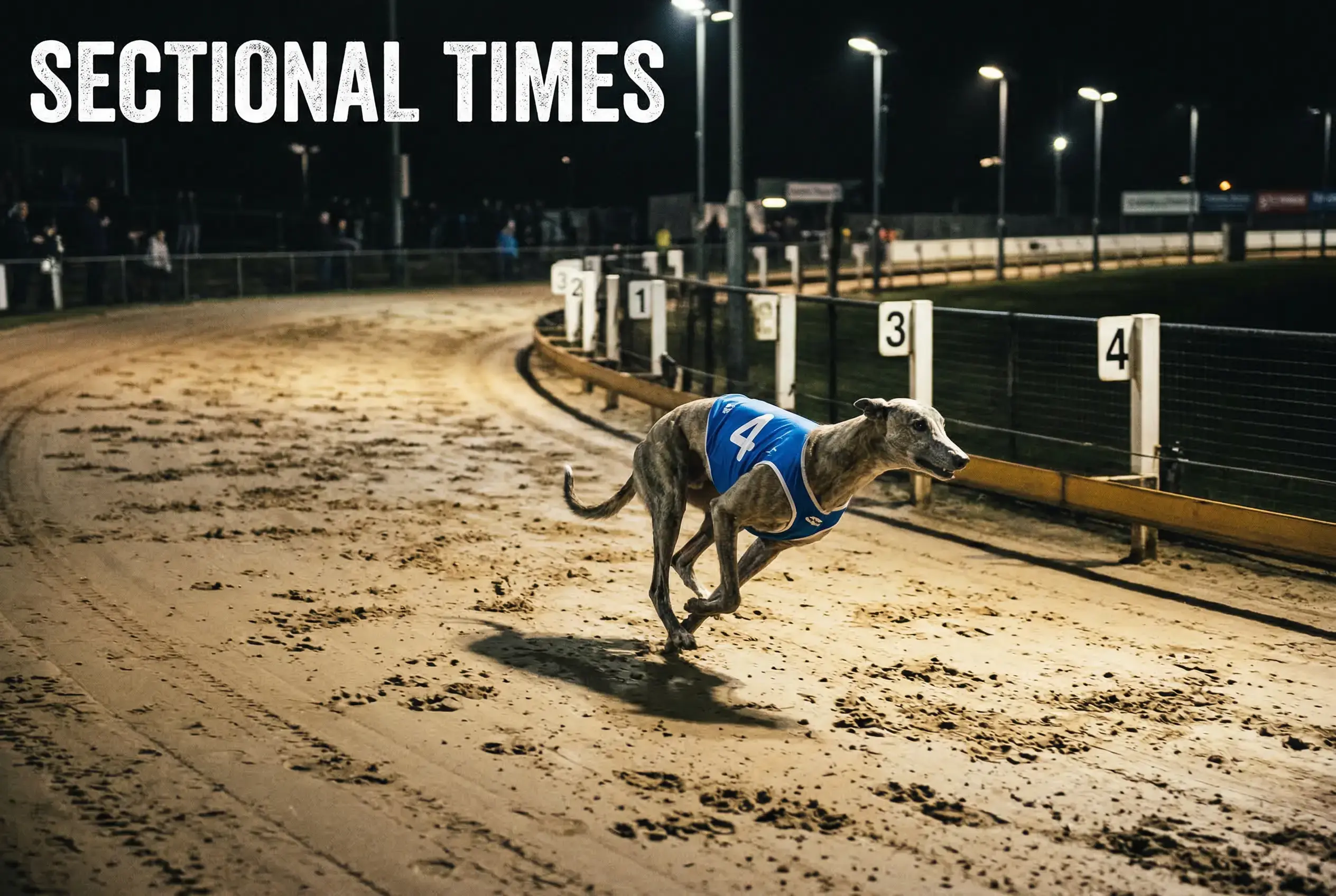
What Sectional Times Tell You That Finishing Times Do Not
A finishing time tells you how fast a dog got from the traps to the line. It does not tell you how the race unfolded. Two dogs can post identical finishing times over 480 metres at Newcastle and have run completely different races — one leading from trap to wire, the other checking at the first bend, losing three lengths and then closing through the field on the run-in. The finishing time treats both performances as equal. Sectional times do not.
Newcastle greyhound sectional times break a race into segments, recording the time taken through each phase. The result is a granular picture of pace distribution: where a dog was fastest, where it lost ground, and whether it was accelerating or decelerating in the final metres. For form analysts, this data transforms a flat result line into a narrative. And narratives, unlike raw times, offer predictive value — because a dog that is consistently quickest through the final section is a dog whose best is yet to come in a given race, not already behind it.
See also: newcastle greyhound results — the Newcastle greyhound racing guide.
How Sections Are Measured at Newcastle
Newcastle’s track has a circumference of 415 metres with a sand surface, and the sectional timing system divides races into phases based on the physical layout. The precise split points depend on the race distance, but the general structure follows a pattern common to most UK greyhound tracks: a run-up from the traps to the first bend, the bends themselves, and a run-in from the final bend to the finishing line.
For a standard 480-metre race at Newcastle, the sections typically cover the initial run to the first bend, the first and second bends as a combined or separate segment, the back straight, the third and fourth bends, and the finishing straight. The number of recorded sections varies depending on the timing technology in use. Some systems record four splits; others capture six or more. The finer the granularity, the more information you have — but even a basic three-section split (early, middle, late) provides substantially more insight than a single finishing time.
The run-up distance at Newcastle — the gap between the starting traps and the first bend — is a crucial section because it determines how much room dogs have to establish position before the field compresses on the turn. A short run-up favours dogs that break cleanly and take the rail quickly. A longer run-up gives wider runners more time to find a racing line without being squeezed. Knowing the run-up distance and how it relates to trap draw is the first step in reading Newcastle sectional times with any intelligence.
Sectional data for Newcastle is available through platforms like GreyhoundStats.co.uk, which compiles track-specific statistics for all GBGB-licensed venues. The depth of sectional coverage depends on the individual meeting and the timing equipment used, but for most standard meetings at Brough Park, at least basic split data is recorded and published.
Interpreting Early Pace, Bend Positions and Run-In Speed
Early pace is the first thing to assess. A dog that records the fastest first-section time in a race is one that breaks sharply and reaches the first bend ahead of — or level with — the field. At Newcastle, where the bends are tight relative to the 415-metre circumference, early pace is worth more than it might be on a larger, more sweeping track. Getting to the rail first avoids the traffic problems that cost lengths on the turns. A fast first section, then, is not just a measure of speed — it is a measure of positional advantage.
Bend positions, recorded either as a time split for the bend sections or as a positional comment (first bend, second bend, third bend), reveal how a race develops through the middle phase. A dog that is first at the first bend and still first at the third bend has controlled the race. A dog that is fourth at the first bend and second at the third has made up ground — which means it was running faster than the leaders through that phase, even if its overall time does not immediately reflect it. The section-by-section comparison is where the real story lies.
Run-in speed — the time recorded from the final bend to the line — is the most underrated section for predictive purposes. A dog that finishes strongly in the run-in is a dog with reserves. If it was held up by traffic on the bends or forced wide by a rival, the run-in split tells you what it might have achieved with a clearer passage. Conversely, a dog that leads through the bends but records a slow run-in is one that is decelerating under pressure, and next time it faces a stronger closer, it may not hold on.
Comparing sectional profiles across multiple runs at the same distance is the most productive use of this data. If a dog consistently records the fastest run-in split but finishes second or third because it is too slow out of the traps, you know exactly what needs to change for it to win: a cleaner break or a more favourable trap draw. That kind of specificity is impossible to extract from finishing times alone.
Using Sectional Data to Assess Newcastle Form
The practical application of Newcastle greyhound sectional times comes down to three questions. First: is this dog’s finishing time a fair reflection of its ability, or was it compromised by something the sectionals can identify? Second: if the dog underperformed, what would need to change — trap draw, pace in the race, going conditions — for it to run closer to its potential? Third: given the likely shape of the next race it enters, do those conditions look more or less favourable?
Discover the history of Brough Park.
Take a concrete scenario. A dog finishes fourth over 480 metres at Newcastle in 29.95 seconds. The finishing time is unremarkable. But the sectional data shows it recorded the fastest run-in split in the field — faster than the winner — and was checked on the second bend, losing at least two lengths. Without the sectional breakdown, this looks like a beaten dog with an ordinary time. With it, this looks like a dog that ran into trouble, overcame it, and still finished within half a second of the winner while posting superior late speed. If it draws a better trap next time and avoids the traffic, the form is significantly better than the bare result suggests.
Ian Walton, General Manager of Newcastle Stadium, has spoken about the value of local knowledge when evaluating performances at Brough Park. That knowledge extends naturally to sectional interpretation. Regulars who watch races at the track develop an instinct for which sections matter most at each distance, which traps tend to produce clean runs to the first bend, and which parts of the track slow down in wet conditions. Sectional data quantifies what experienced observers see with their eyes — it puts numbers to the narrative.
The discipline required is consistency. One set of sectionals from one race is a clue, not a conclusion. Building a genuine form picture from sectional data means comparing the same dog’s splits across three, four or five runs and looking for patterns. A dog that always finishes fast but always starts slow is not going to change overnight. A dog whose early pace has been improving over consecutive runs may be about to put a complete performance together. The sectionals are the evidence; the interpretation is yours.
